

Clock Without Hands
Tags
Summary
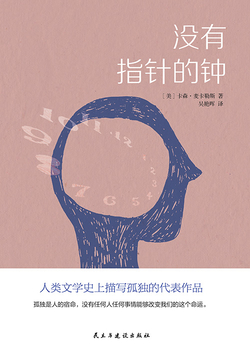
These stories are interlocked. Framed by the symbolic "clock without hands" and centered on "death," the novel spins out multiple themes such as racial discrimination, coming of age, and generational conflict. McCullers tries to combine the personal existential crisis of a dying man with the Southern social crisis caused by racial conflict.
Editor's review
Who it's for
A good fit for
- Readers who prefer literary fiction with strong psychological depth and existential themes
- Readers interested in Southern American literature or the work of Carson McCullers
- Readers who appreciate a slow narrative pace and find meaning in symbol and metaphor
- Thinkers who resonate with explorations of death, loneliness, time, and social alienation
Not a good fit for
- Entertainment-oriented readers seeking fast pacing, strong plot, and dramatic conflict
- Readers uncomfortable with a rather oppressive, melancholic literary atmosphere
Reading tips
- Read it alongside McCullers's earlier works to trace the evolution of her style and sensibility.
- Set aside quiet, uninterrupted time so you can enter the novel's suspended atmosphere.
- Pay attention to the recurring images of "time" and "clocks"; they are key to understanding the novel's central themes.
- After reading, consider extending your reflections to the social and historical context of the mid-twentieth-century American South.
About the publisher
Shanghai Translation Publishing House is a Chinese publisher oriented mainly toward translation and publishing. Its publications cover foreign literature, world classics and classic works, as well as social culture, folk literature and classical poetry. The database contains 2,618 titles, including Never Let Me Go, Les Misérables (2 volumes), Don Quixote (illustrated collector's edition), The Complete Comedies of Molière (4 volumes), The Complete Novels of Kafka (3 volumes), The Collected Works of Dostoevsky (9-volume set), Reason and Persons, and Oedipus Rex (Translation Classics). Its author resources include foreign writers such as Kazuo Ishiguro, Victor Hugo, Cervantes and Molière, as well as translators such as Zheng Kelu, Sun Jiameng, Li Jianwu and Zhang Kun. The publisher has brands such as "Translation Classics Selections" and "Translation Documentary," and emphasizes translated works in foreign literature and the humanities and social sciences, while also publishing bilingual dictionaries and foreign-language educational books. Public information is limited; the above is based on the book information in the database.
Contents
- 版权信息
- Digital Lab简介
- 总序
- 第一章
- 第二章
- 第三章
- 第四章
- 第五章
- 第六章
- 第七章
- 第八章
- 第九章
- 第十章
- 第十一章
- 第十二章
- 第十三章
- 第十四章
- 《没有指针的钟》主题四论——代译后记
FAQ
How does this book differ from Carson McCullers's other works?
What does the title "The Clock Without Hands" signify?
Does the book address racial issues?
Related on WeRead





Comments
Find this book
This site is an index: you start “Search all sources” in your browser, and the entries it lists all point to third-party sites; please judge their availability yourself.
About the author
Carson McCullers (1917–1967) was a representative writer of American Southern literature, born in Columbus, Georgia, and died in Nyack, New York. She produced a number of novels and short works over her lifetime, and the Chinese book database holds twenty-six of her titles, with The Heart Is a Lonely Hunter, The Ballad of the Sad Café, and The Member of the Wedding as her representative works. McCullers is known for writing about loneliness, alienation, and marginalized figures, often focusing on individuals not accepted by mainstream society and portraying the difficulty of communication between people. Her works are commonly classified under social fiction, foreign literature, and world classics, and she has a steady readership in the Chinese-speaking world. Public information about the details of her life is limited; her literary influence rests chiefly on the sustained exploration of loneliness in the works mentioned above.
Sun Shengzhong is listed in the Chinese bibliographic records with two works, commonly classified under foreign literature. Publicly available information about his nationality, dates of birth and death, education, and career is limited, making verification difficult; this introduction can therefore rely only on the existing bibliographic data. The representative works in the database are Reflections in a Golden Eye and The Clock Without Hands. Judging from their titles and classification, both belong to foreign literature and are characterized by strong narrative and symbolic qualities, touching on human nature, time, and fate. The first title suggests expression centered on reflection and observation, while the second evokes themes of disordered time and the human condition. Overall, his translation or editorial work offers Chinese readers readable texts through which to access foreign literature, though further public materials are needed to clarify his specific style and influence.
