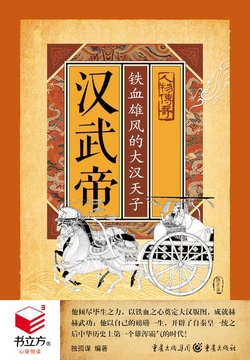
Emperor Wu of Han cover

Emperor Wu of Han

Rating 2.8
Word count
156K words
Chapters
39
ISBN
9787512511439

Tags

Summary

Emperor Wu of Han (156–87 BCE): Liu Che, son of Emperor Jing. Reigned 141–87 BCE. During his reign he adopted Dong Zhongshu's proposal to "revere Confucianism alone," making Confucianism his ruling ideology while also employing Legalist methods and penal names to strengthen his rule. He promulgated the "Decree of Grace" (tuien ling), requiring vassal kings to divide their fiefs among their sons as marquises, thereby weakening separatist forces. He established thirteen regional inspectors to tighten control over the provinces. He levied taxes on merchants' assets to strike at wealthy traders; on Sang Hongyang's advice, he brought iron smelting, salt boiling, and coinage under state monopoly and set up the offices of Stabilization and Equitable Transport, with the government managing transport and trade. He also built water conservancy works, resettled people to the frontier, established military colonies in the northwest, and implemented the "alternating field" method, all conducive to agricultural development. He sent Zhang Qian on two missions to the Western Regions, strengthening control there and promoting economic and cultural exchange. He also sent Tang Meng to Yelang (in present-day Zheng'an, Guizhou) and established seven commanderies in the southwest. He appointed Wei Qing and Huo Qubing as generals to attack the Xiongnu aristocracy, removing the Xiongnu threat and safeguarding economic and cultural development in the north. Owing to his performance of the feng and shan sacrifices, his worship of spirits and quest for immortality, his extravagance, and heavy corvée, many peasants went bankrupt and fled; in the second year of Tianhan (99 BCE), peasant uprisings broke out in Qi, Chu, Yan, Zhao, and Nanyang. In his later years he acknowledged his faults and sought to enrich and nurture the people, creating an opportunity for the Western Han dynasty to turn from crisis to stability. On his deathbed he left an edict making his young son Liu Fuling emperor (Emperor Zhao of Han), with Huo Guang and others as regents.

Editor's review

Hu Yuanbin's Emperor Wu of Han recreates, in plain yet powerfully taut prose, the sweeping life of the most ambitious and strategically gifted emperor of the Western Han. This is no simple biography: it interweaves Liu Che's personal fate with the rise of the Han empire, analyzing the motives and consequences of his decisions against a grand historical backdrop. The author does not dwell on the established achievements of "rejecting the hundred schools and revering Confucianism alone" or the northern campaigns against the Xiongnu, but probes the complex political ecology of Emperor Wu's reign, the social contradictions behind his economic reforms, and the profound self-examination reflected in his late-life "Edict of Luntai." The portrayals of key figures such as Wei Qing, Huo Qubing, Dong Zhongshu, and Sima Qian offer multidimensional perspectives for understanding Emperor Wu's character and era. The value of this book lies in helping us move beyond the binary labels of "wise ruler" and "tyrant" to appreciate a complex ruler striving to balance centralization and territorial expansion, enterprise and depletion—whose experience and lessons remain lastingly instructive for understanding the logic of governance in traditional China.

Who it's for

A good fit for

  • General readers with a strong interest in Western Han history and the era of Emperor Wu
  • Readers seeking more solid historical narrative beyond historical fiction and dramatizations
  • History enthusiasts interested in ancient emperors' statecraft and the mechanisms of power
  • Learners seeking to understand the critical formative period of China's unified dynasties

Not a good fit for

  • Readers seeking light entertainment or novelistic tales of palace intrigue
  • Readers expecting radically subversive historical views or specialized academic monographs

Reading tips

  1. May be read alongside relevant chapters of Sima Qian's Records of the Grand Historian to compare contemporary perspectives with Han-era historical writing
  2. Note the book's discussion of Emperor Wu's economic policies (such as state salt and iron monopolies and the equable transport and stabilization systems), which are key dimensions for understanding his era
  3. May be cross-referenced with the Han chapters of Zizhi Tongjian to appreciate narrative differences under different historical viewpoints

About the publisher

International Culture Publishing Corporation is a publisher known for introducing foreign literature and world classics, with about 283 relevant titles in the database. Its representative books include Goethe's The Sorrows of Young Werther, Hesse's Siddhartha, Jiménez's Platero and I, and Gibran's The Prophet, as well as cultural readings such as Zhu Guangqian's Twelve Letters to Youth and Common Talk on Classics. In psychology, it offers the nine-volume Collector's Edition of C. G. Jung's Works, covering social psychology and applied psychology. Its author resources include Goethe, Hesse, Jiménez, Jung, and Zhu Guangqian, along with Chinese authors involved in translation and compilation. Its publishing focus is on foreign literature, classic works, psychology, and culture, serving both academic and general readers. Public information is limited, and the above is based mainly on the books in the database.

Contents

  1. 版权信息
  2. “中小学课本里的名人传记丛书”前言
  3. 提升汉室实力
  4. 7岁被立为太子
  5. 17岁荣登皇位
  6. 祭祀邂逅卫子夫
  7. 独尊儒术思想
  8. 立五经博士兴太学
  9. 搜罗大批文人学士
  10. 设置音乐官署
  11. 更改历法和服色
  12. 注重水利工程建设
  13. 大力兴建土木工程
  14. 稳定中央政权
  15. 削弱诸侯王势力
  16. 皇权与相权的较量
  17. 设置内廷秘书机构
  18. 建立察举制度
  19. 设立十三部刺史
  20. 改革实施严刑峻法
  21. 高度加强军事力量
  22. 加强中央财政举措
  23. 实施土地兼并措施
  24. 在泰山举行封禅
  25. 拓四方定边患
  26. 大破匈奴之战
  27. 远征讨伐大宛
  28. 平灭南越叛乱
  29. 开拓西南夷地区
  30. 东征朝鲜定四郡
  31. 平定羌人叛乱
  32. 派张骞出使西域
  33. 晚年悔痛人生
  34. 废除陈阿娇皇后
  35. 平息巫蛊之乱
  36. 重新设立继承人
  37. 颁布《轮台之诏》
  38. 重视发展农业
  39. 真情托付后事

FAQ

What is the book's historical viewpoint and stance?
The book maintains a generally balanced and cautious stance: it affirms Emperor Wu's historical contributions in expanding territory, consolidating central power, and establishing a cultural mainstream, while not shying away from the hardship caused by years of warfare, the tensions of harsh officialdom, and the social crisis that emerged in his later years. The author seeks to present a rounded, multifaceted portrait of the emperor.
How difficult is the book? Does it require much prior historical knowledge?
The language is accessible and fluent, the narrative clear, and the author explains necessary background, making it suitable as an introductory read on Emperor Wu. A basic grasp of the historical context suffices; no deep specialized knowledge is required.
What are the book's main distinguishing features compared with works on similar subjects?
Compared with works emphasizing military exploits or court intrigue, this book places Emperor Wu more within the framework of the Han empire's institutional evolution and social change, offering relatively detailed treatment of his domestic reforms, economic measures, and cultural policies, and providing a comparatively comprehensive picture.

Related on WeRead

Comments

Find this book

This site is an index: you start “Search all sources” in your browser, and the entries it lists all point to third-party sites; please judge their availability yourself.

About the author

Hu Yuanbin Author · China · 1963

Hu Yuanbin was born in November 1963 in Fang County, Hubei Province. He graduated from Hubei Education College and is a member of the Hubei Provincial Writers Association. He has long been engaged in book editing and popular writing, having compiled and written hundreds of books on biography, historical stories, and traditional Chinese culture. His works number 203 in the library, including representative titles such as Journey to the West, Water Margin, Wandering, Suixiju Diet Manual, and The Splendid Scenes of the Imperial Palace. His common categories cover inspirational growth, health, culture, medicine, historical reading, and film and television. His works show a focus on accessible writing for general readers, turning literary classics, historical knowledge, and dietary and medical common sense into easy-to-read volumes. Public information is limited, and details of his specific career are difficult to elaborate, but through his considerable output he has achieved broad coverage in the field of popular reading.

More by the same author

Top rated in the same category