

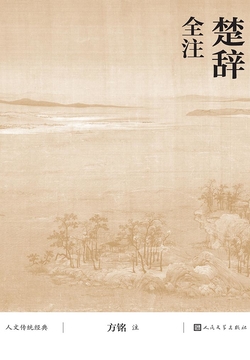
Complete Translation of the Songs of Chu
Tags
Summary
Editor's review
As an editor, I believe the book's greatest value lies in its perfect balance between scholarship and accessibility. The annotations not only explain words and allusions but also delve into the cultural background, mythological system, and Qu Yuan's political ideals of the Chu region during the Warring States period, constructing a three-dimensional reading context for the reader. Particularly noteworthy is Mr. Huang Shouqi's method of "translating poetry as poetry," which avoids both the loss of flavor caused by excessive modernization and the barriers to understanding posed by classical Chinese.
Compared with other translations of Chu Ci on the market, this book is distinctive for its appendix, which collects summaries of important commentaries from successive dynasties, from Wang Yi of the Han Dynasty to Dai Zhen of the Qing Dynasty, forming a genealogy of interpretation spanning two thousand years. This arrangement allows readers not only to understand Chu Ci but also to understand how Chu Ci has been interpreted and transmitted by men of letters through the ages. For readers who wish to understand deeply the source of Chinese romantic literature and explore Qu Yuan's spiritual world, this complete translation offers reliable and rich textual support.
Who it's for
A good fit for
- Readers interested in classical Chinese literature, especially pre-Qin poetry
- University students of Chinese literature and researchers of ancient literature
- Enthusiasts who wish to gain a systematic understanding of Qu Yuan's works and the Chu culture of the Warring States period
- Writers engaged in literary creation who seek nourishment from traditional culture
Not a good fit for
- Young readers seeking simplified children's editions or comic adaptations
- Readers who only wish to skim famous lines and excerpts without engaging deeply with the text
Reading tips
- It is recommended to read the preface first to understand Mr. Huang Shouqi's translation philosophy and the basic features of Chu Ci
- Reading alongside historical maps of the Warring States period and archaeological materials on Chu culture is advised to enhance spatial understanding
- Key pieces such as Li Sao can be read repeatedly passage by passage to appreciate the progressive layers of Qu Yuan's emotion
About the publisher
Beijing United Publishing Co., Ltd. is a publisher known for its literature and history titles, with 2,065 books in the collection. Its publishing covers foreign literature, contemporary Chinese prose and essays, history, folk literature, and cultural books. Its list ranges from Sima Qian's complete edition of the Records of the Grand Historian to foreign classics such as The Book of Disquiet, All Quiet on the Western Front, Snow Country, The Stranger, and Jean-Christophe, as well as modern Chinese works including Teahouse and Dawn Blossoms Plucked at Dusk. Its authors and translators include Yasunari Kawabata, Fernando Pessoa, Erich Maria Remarque, Jin Xinyi, Zhou Miao, and Chen Chao. Public information is limited, but its catalogue reflects a balance between Chinese and foreign literary classics and historical and cultural works.
Contents
- 版权信息
- 前言
- 离骚
- 九歌
- 东皇太一
- 云中君
- 湘君
- 湘夫人
- 大司命
- 少司命
- 东君
- 河伯
- 山鬼
- 国殇
- 礼魂
- 天问
- 九章
- 惜诵
- 涉江
- 哀郢
- 抽思
- 怀沙
- 思美人
- 惜往日
- 橘颂
- 悲回风
- 远游
- 卜居
- 渔父
- 九辩
- 招魂
- 大招
- 惜誓
- 吊屈原
- 鵩鸟赋
- 招隐士
- 七谏
- 初放
- 沈江
- 怨世
- 怨思
- 自悲
- 哀命
- 谬 谏
- 哀时命
- 九怀
- 匡机
- 通路
- 危俊
- 昭世
- 尊嘉
- 蓄英
- 思忠
- 陶壅
- 株昭
- 九叹
- 逢纷
- 离世
- 怨思
- 远逝
- 惜贤
- 忧苦
- 愍命
- 思古
- 远游
- 九思
- 逢尤
- 怨上
- 疾世
- 悯上
- 遭厄
- 悼乱
- 伤时
- 哀岁
- 守志
- 附录
FAQ
What are the main differences between this translation and other translations of Chu Ci?
Can readers without a foundation in classical Chinese understand it?
Does the book include disputed pieces such as Summons of the Soul and The Great Summons?
Related on WeRead




Comments
Find this book
This site is an index: you start “Search all sources” in your browser, and the entries it lists all point to third-party sites; please judge their availability yourself.
About the author
Huang Shouqi is an author about whom limited public information is available; details such as his native place, dates of birth and death, and educational background are not clearly recorded. Judging from the three works held in the collection, his writing centers on ancient Chinese classics, including two editions of An Annotated Translation of the Zhouyi (Book of Changes) and A Complete Translation of the Chu Ci (Songs of Chu). These are annotated translations and popularizations of classical texts aimed at general readers, seeking to present the original content and thought of works such as the Zhouyi and the Chu Ci in fluent, accessible modern Chinese. In common classifications his works fall under history, culture, and Eastern philosophy, indicating that his focus is the organization and dissemination of traditional cultural classics. Overall, Huang Shouqi's contribution lies in lowering the barrier to reading through annotated translation and helping readers approach pre-Qin thought and literary traditions; given the limited material, his academic career and broader influence remain to be further verified.
Mei Tongsheng is a Chinese author about whom limited public information is available, and relatively little can be confirmed regarding his identity and life experience. Within the holdings of this library, his representative work is a complete modern Chinese translation of the Chu Ci (Songs of Chu), a title commonly classified under Eastern philosophy. This suggests that Mei Tongsheng's writing focuses on the collation and translation of classical Chinese literary and philosophical texts, particularly the annotation, vernacular rendering, and popularization of Qu Yuan and the Chu Ci tradition. The Complete Translation of the Chu Ci is aimed at general readers, seeking to lower the barrier to reading while preserving the meaning and flavor of the original, so that the imaginative world and emotional expression of pre-Qin Chu poetry become more accessible to modern readers. Such complete translations serve as a bridge in transmitting ancient texts, supporting teaching and introductory reading while making the Chu Ci available to a broader audience. Owing to the lack of further public information, details of his academic background, other writings, and research career cannot be described here.
