

Tags
Summary
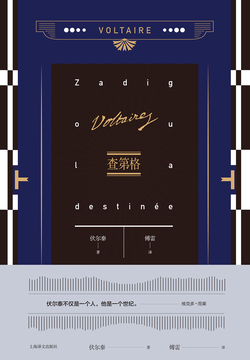
Editor's review
The novel's greatest refinement lies in its dual narrative structure: on the surface an adventure story full of exotic charm, beneath which lies a sharp dissection of contemporary French society and, indeed, of the universal human predicament. Each time Zadig tries to solve a problem through reason, he is often thwarted by irrational fate—an irony that reveals Voltaire's core idea: the value and difficulty of upholding reason in an irrational world.
In this Shanghai Translation Publishing House edition, the translation accurately conveys the original's concise and witty style, and the annotations provide modern readers with the necessary guidance for understanding the eighteenth-century cultural context. Notably, though short, the work is extremely dense, with nearly every chapter containing philosophical propositions worth savoring repeatedly.
In terms of reading value, Zadig is not only a literary classic but also a key to understanding the intellectual currents of the Enlightenment. Earlier than Candide, it embodies Voltaire's conception of philosophical fiction, showing how the author transformed profound philosophical thought into vivid, readable narrative art. For contemporary readers, the absurd predicaments Zadig encounters can still prompt reflection on the absence of reason and the unpredictability of fate in modern society.
Who it's for
A good fit for
- Readers interested in Enlightenment thought and literature
- Readers who love philosophical fiction and literature of ideas
- Students seeking to understand the characteristics of Voltaire's literary creation
- Readers who appreciate satirical literature and allegorical narrative
Not a good fit for
- Readers expecting pure adventure stories or light entertainment
- Readers completely unfamiliar with eighteenth-century cultural context who are unwilling to consult annotations
Reading tips
- Read alongside Voltaire's life and other works (such as the Philosophical Dictionary and Candide) for comparison
- Note the social critique and philosophical reflection hidden behind the seemingly absurd plot
- Slow down your reading pace and savor the aphorisms and reflections at the end of each chapter
About the publisher
Shanghai Translation Publishing House is a Chinese publisher oriented mainly toward translation and publishing. Its publications cover foreign literature, world classics and classic works, as well as social culture, folk literature and classical poetry. The database contains 2,618 titles, including Never Let Me Go, Les Misérables (2 volumes), Don Quixote (illustrated collector's edition), The Complete Comedies of Molière (4 volumes), The Complete Novels of Kafka (3 volumes), The Collected Works of Dostoevsky (9-volume set), Reason and Persons, and Oedipus Rex (Translation Classics). Its author resources include foreign writers such as Kazuo Ishiguro, Victor Hugo, Cervantes and Molière, as well as translators such as Zheng Kelu, Sun Jiameng, Li Jianwu and Zhang Kun. The publisher has brands such as "Translation Classics Selections" and "Translation Documentary," and emphasizes translated works in foreign literature and the humanities and social sciences, while also publishing bilingual dictionaries and foreign-language educational books. Public information is limited; the above is based on the book information in the database.
Contents
- 版权信息
- 查第格
- 一 独眼人
- 二 鼻子
- 三 狗与马
- 四 眼红的人
- 五 侠义的人
- 六 宰相
- 七 调解与接见
- 八 嫉妒
- 九 挨打的女人
- 一〇 奴役
- 一一 殉夫
- 一二 晚餐
- 一三 约会
- 一四 强盗
- 一五 渔夫
- 一六 四脚蛇
- 一七 比武
- 一八 隐士
- 一九 猜谜
- 如此世界 巴蒲克所见的幻象——巴蒲克记
- 梅农 或人的智慧
- 两个得到安慰的人
- 小大人 哲学故事
- 一 一个天狼星系的居民游历土星
- 二 天狼星居民与土星居民的谈话
- 三 天狼星居民与土星居民的旅行
- 四 他们在地球上的遭遇
- 五 两位旅客的实验与讨论
- 六 他们与人类的接触
- 七 与人类的谈话
FAQ
What is the difference between Zadig and Candide?
Can I understand this book without a philosophy background?
What are the features of this translation?
Related on WeRead




Comments
Find this book
This site is an index: you start “Search all sources” in your browser, and the entries it lists all point to third-party sites; please judge their availability yourself.
About the author
Voltaire (1694–1778), born François-Marie Arouet, was an 18th-century French Enlightenment thinker, man of letters, philosopher and historian, hailed as "the king of French thought." He championed freedom of belief, freedom of speech and judicial fairness, and sharply criticized religious fanaticism and despotic rule, exerting a profound influence on public opinion before the French Revolution and on the European Enlightenment. In literature he is known for his philosophical tales, which use invented stories and satire to explore fate, suffering and reason. This collection includes 18 of his works, among them the philosophical novels Candide, L'Ingénu and Zadig, as well as Volume 10 of the Voltaire Collected Works and Fu Lei's translations of his philosophical fiction. Classified under foreign literature, philosophy, world classics and social fiction, these works remain witty and incisive, offering Chinese readers an important gateway to Enlightenment literature.
Fu Lei (1908–1966), styled Nu'an and known by the sobriquet Nu'an, was a native of Nanhui, Shanghai, and a renowned Chinese translator, writer and literary critic. He studied at the University of Paris in his early years and devoted his life to translating more than thirty works by French masters such as Balzac, Romain Rolland and Voltaire. Adhering to the principle of valuing spiritual resemblance over formal likeness, his translations are celebrated for their vividness and concision and are still widely read today. His renditions of Jean-Christophe, Le Père Goriot and Eugénie Grandet have long served as key pathways for Chinese readers into French literature. Beyond translation, he wrote Letters from Fu Lei and Twenty Lectures on World Masterpieces of Art, works marked by sincerity and learning. The library holds 295 of his works, spanning essays, foreign literature and classic translations, testifying to the enduring influence of his writing and translation in the Chinese-speaking world.
