

Essence
Tags
Summary
Editor's review
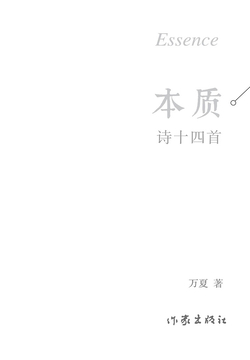
This is not a plot-driven novel in the traditional sense, but rather a 'spiritual autobiography' written in fictional form. Through fragmented narration, jump-cut scenes and highly condensed dialogue, it explores such essential questions as art, life, existence and nothingness. Readers can clearly sense the author bringing the condensed aesthetics of poetry into prose narrative, so that every page of the text is filled with images and philosophical reflection to be savored. This approach made Essence something of an outlier among the novels of its year, and a more challenging one.
In terms of reading value, it offers the possibility of quietly observing one's inner world in a clamorous age. It provides no cheap consolation or smooth story, but invites the reader into a space of contemplation and self-dialogue. For readers familiar with Wan Xia's poetry, it is a key to understanding the thread of his thought; for lovers of literature, it is a sample of how a poet 'crosses over' into narrative. Its value lies not in the completeness of story but in the sparks struck when language meets thought, and in its individualized, literary interrogation of the grand theme of 'essence'.
Who it's for
A good fit for
- Readers interested in contemporary Chinese poetry, especially the 'Third Generation Poetry' movement
- Readers who enjoy speculative, linguistically dense, experimentally structured literary fiction
- Readers who wish to discover another side of Wan Xia's literary expression beyond poetry
- Those seeking philosophical contemplation and spiritual introspection through reading
Not a good fit for
- Readers expecting a strong plot, fast pace and clearly drawn characters
- Beginners lacking patience for fragmented, meditative narrative
Reading tips
- Read it as a long prose poem or intellectual notebook rather than pursuing the coherence of a traditional novel
- Pay attention to how the author translates poetic imagery into scene and atmosphere in the novel
- After reading, turn to Wan Xia's poetry collections and compare how he handles similar themes in different genres
About the publisher
Writers Publishing House is a Chinese publisher focused mainly on literary publishing. Its output covers classical literature, foreign literature, folk literature and Eastern philosophy, with some extension into popular reading such as social fiction and parenting books. Its catalogue contains more than 900 titles, including representative works such as Dream of the Red Chamber and its edited editions, Shakespeare's Macbeth and A Midsummer Night's Dream, and foreign literary classics such as The Brothers Karamazov and Lost Illusions. In terms of authors, it includes classical writers such as Cao Xueqin and Gao E, foreign masters such as William Shakespeare, Dostoevsky and Balzac, and translations by translators such as Zhu Shenghao, Geng Jizhi and Fu Lei. Overall, its publishing profile balances Chinese and foreign literary classics, emphasizes quality translations, and serves both academic and general readers; publicly available information on its specific publishing plans is limited.
Contents
- 版权信息
- 空气、皮肤和水
- 渡光阴的人
- 樱桃树下
- 本质
- 词,内心
- 词,房子
- 词,刀锋
- 纯粹的人
- 吕布之香 ——献给郭力家
- 诗人无饭
- 一生
- 月落
- 农事的五首诗(选二首)
- 后记
FAQ
Is this book a novel or an essay collection?
Will not having read Wan Xia's poetry affect my understanding of this book?
How difficult is this book to read?
Related on WeRead

Comments
Find this book
This site is an index: you start “Search all sources” in your browser, and the entries it lists all point to third-party sites; please judge their availability yourself.
About the author
Wan Xia is a Chinese author of modern poetry, about whom public information is limited and whose exact biographical details have not yet been systematically disclosed. The library currently holds two of his works, "Mourning" (Sang) and "Essence" (Benzhi), commonly classified under classic works and modern poetry. Judging from the titles and classifications of these two works, his writing tends to address relatively abstract themes through concise poetic language, centering on existence, authenticity, and emotional experience, with the introspective temperament and restrained expression characteristic of modern poetry. Based on the available material, the scale and reception of Wan Xia's writing remain unclear, making it difficult to determine his specific place and influence in the poetry scene; nevertheless, the two works "Mourning" and "Essence" themselves provide a basic entry point for understanding his writing. Readers interested in the author and his poetry may begin with these two works to appreciate his language style and thematic concerns, and may supplement this with later public information.
