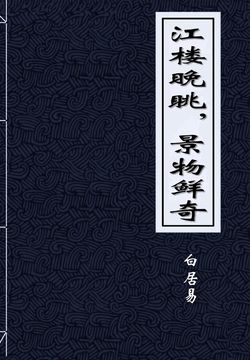
Evening Gaze cover

Evening Gaze

Rating 3.8
Word count
3.9K words
Chapters
4

Tags

Summary

Traditional Chinese thought has a long history and is highly original, inventive, and literary. Early intellectual forms are distinctive: religious theology, classical Chinese medical texts, ancient military strategy, Confucianism, Daoism, Buddhism, and the Hundred Schools of Thought, feng shui and metaphysics, the Twenty-Four Histories, and local customs and gazetteers—all are profound and extensive. This "Essence of Classic Chinese Culture: Original Texts" series preserves the appearance of the original books and focuses on preserving and transmitting traditional Chinese thought and culture. By reading the literary essence left by ancient sages, readers cultivate character and subtly engage with the classics of Chinese learning.

Editor's review

Although titled after Su Shi's "Gazing into the Distance at Dusk," this book is one volume in the "Essence of Classic Chinese Culture: Original Texts" series. Its value lies in presenting traditional poetry and prose in their original form, allowing readers to experience the flavor of classical poetry in texts not over-interpreted. The highlight is that it preserves the original appearance without deletion or alteration, making it suitable for slow, careful reading in a quiet setting, using one poem as an entry point to a broader perception of traditional thought and literary essence. Readers need not rush to interpret; they can first read the main text through, then revisit it alongside annotations and background materials, cultivating character through repeated immersion and quietly drawing closer to the classics of Chinese learning.

Who it's for

A good fit for

  • General readers who wish to encounter classical poetry and prose in their original form
  • Enthusiasts of Chinese classics who need short pieces for daily recitation practice
  • Students who want to use a single work as a gateway to traditional cultural contexts

Not a good fit for

  • Beginning readers expecting detailed modern annotations and line-by-line translation
  • Readers seeking a systematic methodology for poetry appreciation or academic textual research

Reading tips

  1. First read the whole poem once or twice without consulting references, noting first impressions and questions.
  2. Then compare with the original text preserved in the book, paying attention to word choice and sentence patterns.
  3. Reread at a fixed time each week, using notes to record how your understanding changes.

Contents

  1. 版权信息
  2. 晚眺
  3. 卷六百六十三
  4. 卷六百六十四

FAQ

Does this book contain only one poem?
From the available information, this book belongs to the "Essence of Classic Chinese Culture: Original Texts" series and is titled "Gazing into the Distance at Dusk," focusing on preserving the original appearance of the book and transmitting traditional thought and culture. The exact table of contents should be confirmed against the physical book; before purchasing, check the contents or a sample page to confirm the scope of inclusion.
Can I read it without a background in classical Chinese?
Yes, but this book emphasizes preserving the original text, so modern annotations and translations may be limited. It is advisable to have a reliable dictionary of classical Chinese or related appreciation materials on hand for support: first experience the text, then gradually verify words and background.
Is it suitable as recitation material?
Yes. It is short and concise in language, convenient for recitation at a fixed time each day. It is recommended to first read silently to confirm pronunciation, then read aloud, and afterward retell the general meaning in your own words—this practices language sense and deepens understanding of traditional poetry and prose.

Related on WeRead

Comments

Find this book

This site is an index: you start “Search all sources” in your browser, and the entries it lists all point to third-party sites; please judge their availability yourself.

About the author

Su Shi Author · China (Northern Song dynasty) · 1037–1101

Su Shi (1037–1101), courtesy name Zizhan and literary name Dongpo Jushi, was a native of Meishan in Meizhou (present-day Meishan, Sichuan) and a writer, calligrapher, painter, and statesman of the Northern Song dynasty. He excelled in poetry, ci lyrics, prose, and fu, and was one of the Eight Great Prose Masters of the Tang and Song. His ci opened the bold and unconstrained school, and his calligraphy ranks first among the Four Masters of Song. The collection contains twenty-eight of his works, including Dongpo Yuefu jian, Dongpo zhilin, Su Shi ciji, Lun shu, Chao Cuo lun, and Dongpo ji, covering poetry, historical essays, miscellaneous notes, and writings on calligraphy and painting. His prose is sweeping and unrestrained, his poetry clear and vigorous, and his ci broke through the confines of delicate romance, using poetry as the basis for ci and broadening both its subjects and its scope, while his brief occasional pieces are casually sketched yet rich in feeling. His work has had a profound influence on later literature, calligraphy and painting, and literati life, and has long been regarded as classic, often placed in the categories of ancient poetry, Eastern philosophy, and literary appreciation.

More by the same author

Top rated in the same category