

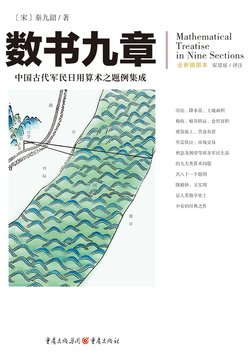
Mathematical Treatise in Nine Sections
Tags
Summary
The book was selected by compilers of the Ming and Qing dynasties into the Yongle Encyclopedia and the Complete Library of the Four Treasuries, respectively, both monumental collections of Chinese ancient texts. As a pinnacle of ancient Chinese mathematics, Mathematical Treatise in Nine Sections summarizes the main achievements of traditional Chinese mathematics during the Song and Yuan periods and represents a comprehensive inheritance and transcendence of The Nine Chapters on the Mathematical Art; today's mathematical community hails it as "a monument in the development of medieval mathematics."
Mathematical Treatise in Nine Sections flexibly applies the calculation methods proposed in earlier mathematical works such as Master Sun's Mathematical Manual and The Nine Chapters on the Mathematical Art to practical problems, and puts forward several innovative algorithms that were ahead of the rest of the world at the time.
The book is divided into nine chapters in eighteen volumes, with one chapter per category: the "Great Expansion" category, "Heavenly Time" category, "Field Areas" category, "Surveying and Observation" category, "Taxes and Corvée" category, "Money and Grain" category, "Construction" category, "Military Affairs" category, and "Market Goods" category, with each category spread across two volumes. Each category contains 9 problems, for a total of 81 problems. The content is extremely rich, ranging from astronomy, celestial phenomena, calendars and pitch standards, and meteorological observation to river courses, water conservancy, architecture, and transportation, as well as calculations and exchanges involving various geometric figures and volumes, money and grain, taxes and corvée, markets, and brokerage fees, fully reflecting the Chinese view of mathematics and of life.
Editor's review
Who it's for
A good fit for
- Readers interested in the history of ancient Chinese mathematics and the history of science and technology
- Mathematics enthusiasts willing to read classical Chinese problems slowly and work through calculations as they go
- Students and teachers who need primary sources for research or teaching reference
- History readers who enjoy seeing ancient social life through concrete problems
Not a good fit for
- Readers hoping for a light look at mathematical curiosities who do not want to engage with classical Chinese problems
- People lacking basic algebra and geometry who want only stories
- Readers seeking fast-paced reading who are unaccustomed to working through problems one by one
Reading tips
- Start with the editor's introduction and notes on terminology to understand the nine-chapter classification before tackling the problems.
- Pick one or two problems from each category to work through by hand; there is no need to read all eighty-one.
- When encountering ancient terms, consult the notes and related methods in The Nine Chapters on the Mathematical Art rather than skipping ahead.
- Read the problems alongside the social context of the Southern Song, paying attention to real-world information in categories such as taxes and corvée and construction.
About the publisher
Chongqing Publishing House is a comprehensive publisher known for its titles in the humanities, social sciences, literature and arts, with about 940 books in its catalogue. Its publishing areas cover world history, science fiction, foreign literature, architecture and philosophy. Representative titles include Xiang Da's A History of Communications Between China and the West, Liang Sicheng's Rules of Qing-Style Construction, Liu Cixin's The Three-Body Problem II: The Dark Forest and III: Death's End, Ann Rand's The Fountainhead (25th Anniversary Edition), and Brandon Sanderson's Stormlight Archive series. Its authors include Xiang Da, Liu Cixin, Liang Sicheng and Ann Rand. The press has developed distinctive strengths in historical source editing, the introduction and creation of science fiction, the translation of foreign literature, and architecture and philosophy titles, balancing scholarly value with general readership. As public information is limited, this profile outlines its publishing directions based only on the books in the catalogue.
Contents
- 版权信息
- 非凡的阅读
- 译注者序
- 导读
- 秦九韶原序
- 第一章 大衍类
- 卷一
- 蓍卦发微
- 古历会积
- 推计土功
- 推库额钱
- 卷二
- 分粜推原
- 程行计地
- 程行相及
- 积尺寻源
- 余米推数
- 第二章 天时类
- 卷三
- 推气治历
- 治历推闰
- 治历演纪
- 缀术推星
- 卷四
- 揆日究微
- 天池测雨
- 圆罂测雨
- 峻积验雪
- 竹器验雪
- 第三章 田域类
- 卷五
- 尖田求积
- 三斜求积
- 斜荡求积
- 计地容民
- 蕉田求积
- 均分梯田
- 卷六
- 漂田推积
- 环田三积
- 围田先计
- 第四章 测望类
- 卷七
- 望山高远
- 临台测水
- 陡岸测水
- 卷八
- 表望方城
- 遥度圆城
- 望敌圆营
- 望敌远近
- 古池推元
- 表望浮图
- 第五章 赋役类
- 卷九
- 复邑修赋
- 卷十
- 围田租亩
- 筑埂均功
- 宽减屯租
- 户田均宽
- 均科绵税
- 户税移割
- 移运均劳(分郡县乡科均)
- 均定劝分
- 第六章 钱谷类
- 卷十一
- 折解轻赍
- 算回运费
- 课籴贵贱
- 卷十二
- 囤积量容
- 积仓知数
- 推知籴数
- 分定网解
- 累收库本
- 米谷粒分
- 第七章 营建类
- 卷十三
- 计定城筑
- 楼橹功料
- 计造石坝
- 计浚河渠
- 卷十四
- 计作清台
- 堂皇程筑
- 砌砖计积
- 竹围芦束
- 积木计余
- 第八章 军旅类
- 卷十五
- 计立方营
- 方变锐阵
- 计布圆阵
- 卷十六
- 圆营敷布
- 望知敌众
- 均敷徭役
- 先计军程
- 军器功程
- 计造军衣
- 第九章 市物类
- 卷十七
- 推求物价
- 均货推本
- 互易推本
- 菽粟互易
- 卷十八
- 推计互易
- 炼金计值
- 推求本息
- 推求典本
- 僦直推原
- 计量单位换算一览表
FAQ
Can I read this book without a foundation in classical Chinese?
What is the relationship between Mathematical Treatise in Nine Sections and The Nine Chapters on the Mathematical Art?
Do the problems in the book still have practical use today?
Related on WeRead


Comments
Find this book
This site is an index: you start “Search all sources” in your browser, and the entries it lists all point to third-party sites; please judge their availability yourself.
About the author
Qin Jiushao was a renowned mathematician in ancient China. Because historical sources about his life and official career are scattered, the publicly available material is limited and hard to describe in detail. One work by him, Mathematical Treatise in Nine Sections (Shu Shu Jiu Zhang), survives as his representative masterpiece and an important classic in the history of Chinese mathematics. The book is arranged as a collection of problems and deals with mathematical calculations in practical affairs such as land measurement, surveying, taxation and corvée, money and grain, construction, and military logistics. Its contents cover numerical solutions of higher-degree equations, methods for solving systems of linear congruences, geometric measurement, and the calculation of areas and volumes, reflecting an emphasis on practical use and algorithmic procedures. Qin Jiushao writes in a clear and orderly manner, often presenting each problem with a question, an answer, and a method, and his derivations are relatively complete, making the work useful in his own time and an example for later mathematical research. The algorithmic ideas embedded in his methods had a profound influence, and he occupies an important place in the traditional Chinese mathematical system.
Song Jingyao is an author for whom only limited public information is currently available; details such as place of origin, dates of birth and death, and educational background have not been clearly recorded. According to the library's holdings, she has only one work to her name, Mathematical Treatise in Nine Sections (Shu Shu Jiu Zhang), classified under popular science. The book takes an ancient Chinese mathematical work as its subject and involves the collation and interpretation of mathematical classics, placing it in the genre of science writing aimed at general readers. Because further biographical material is lacking, her professional identity and writing career cannot be confirmed, nor can it be determined whether the book is an original work, a translation, or an adaptation. On the basis of the available information, Song Jingyao's writing profile centers on attention to traditional mathematical texts and their popular presentation, and her work offers readers an entry point for understanding the mathematical heritage of Mathematical Treatise in Nine Sections. More complete author information remains to be supplied by public sources.
