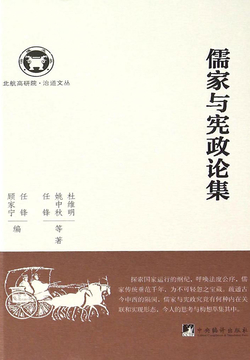
On Government cover

On Government

Rating 3.8
Word count
12K words
Chapters
4

Tags

Summary

Traditional Chinese culture and thought have a long history, marked by a high degree of originality, inventiveness, and literary quality. Early thought forms are highly distinctive: religious theology, classical texts of Chinese medicine, ancient military strategy, Confucianism, Daoism, Buddhism and the Hundred Schools of Thought, feng shui and metaphysics, the Twenty-Four Histories, customs and local gazetteers—these subjects are profound and extensive. This series, "Essential Classics of Chinese Culture: Original Texts," preserves the original appearance of the books and focuses on preserving and transmitting traditional Chinese thought and culture. By reading the literary essence left by ancient sages, readers cultivate character and quietly absorb the classics of Chinese learning.

Editor's review

Zheng Lun (On Government) is a surviving political treatise by Cui Shi of the Eastern Han dynasty. In this "Essential Classics of Chinese Culture: Original Texts" series it retains its original appearance and is suitable as an introductory reader for understanding Han-era political thought and traditional ideas of governance. Its value lies not in literary ornament but in a mode of argument that directly addresses the successes and failures of official administration, people's livelihood, and institutions, allowing today's readers to see how ancient scholars discussed real politics. The views in the book bear the clear imprint of their era; when reading, one should appreciate its concern with reality while also noting the differences between ancient and modern institutional contexts. If you are systematically approaching original Chinese classics, or wish to understand traditional political discourse from the perspective of intellectual history, this book is short but information-dense, and is suited to slow reading, excerpting, and understanding with the help of annotations.

Who it's for

A good fit for

  • Readers interested in Han-era political thought and traditional ideas of governance who wish to read the original text
  • General readers who have some grounding in Chinese classics and want to go further into ancient political treatises
  • Students of history, political science, or intellectual history using it as supplementary reading material

Not a good fit for

  • Readers who only want light stories or simple popular books on Chinese classics
  • Readers expecting a modern political-science analytical framework and unwilling to accept the ancient context
  • First-time readers lacking a foundation in classical Chinese who are unwilling to consult annotations

Reading tips

  1. First read the preface or publisher's note to understand Cui Shi's era and the nature of the book, then enter the main text.
  2. After reading each passage, close the book and restate its core argument, summarizing the thesis and evidence in your own words.
  3. Mark institutional and proper terms first and look them up together in annotations or reference works, rather than struggling over every word.
  4. Read alongside relevant chapters of the Book of Han and the Book of the Later Han to understand the historical background that produced the political treatise.

Contents

  1. 版权信息
  2. 《政论》
  3. 一
  4. 二

FAQ

Can I read this book without a foundation in classical Chinese?
You can try, but you will need annotations and reference works. This book preserves the original appearance of the text and focuses on preserving traditional thought and culture; it is not a vernacular rewrite. It is advisable first to read the publisher's note to understand the background of the book, then read paragraph by paragraph alongside the annotations; if the classical Chinese is a major obstacle, you can first read an annotated selection or a related guide, then return to the original.
What is this book mainly about?
According to the materials, it is a political treatise among traditional original Chinese classics, written by Cui Shi of the Eastern Han. When reading, focus on how it discusses official administration, people's livelihood, and institutional successes and failures, rather than treating it as a modern work of political science. For the content of specific chapters, refer to the main text of the book, and it is advisable to understand it in light of its historical background.
Is it suitable for reading straight through from beginning to end?
It is short enough to read through, but reading it slowly in sections is recommended. After each section, first summarize the argument, then review the key sentences; this is more rewarding than flipping through it in one go. If time is limited, you can first closely read passages related to official administration and people's livelihood, then read the rest.

Related on WeRead

Comments

Find this book

This site is an index: you start “Search all sources” in your browser, and the entries it lists all point to third-party sites; please judge their availability yourself.

About the author

崔寔 Author

Cui Shi was an important author of the Eastern Han period, though details of his life are now difficult to establish, and publicly available information is limited. Two of his works are included here: the Siyue Ling and the Zheng Lun. Judging by their subject matter, the Siyue Ling records farming and household livelihood month by month, covering cultivation, sericulture and weaving, food, medicine, and buying and selling as part of daily arrangements. It combines seasonal knowledge with practical guidance, and later generations have often regarded it as important material for studying rural life and the agricultural economy of the Han dynasty. The Zheng Lun, by contrast, discusses contemporary politics, focusing on social governance and real abuses, in a pragmatic and direct style. One work emphasizes practical life, the other political criticism, and together they reflect Cui Shi's realistic, utility-oriented approach to writing, which also gives him a place in the social sciences and medicine-related categories.

More by the same author

Top rated in the same category