

The Price of Government
Tags
Summary
Editor's review
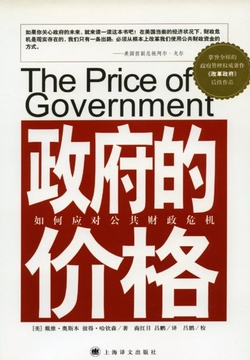
In the editor's view, the book's value for readers operates on three levels. First, it offers a clear analytical framework (such as "results-based budgeting") that helps readers move beyond the binary debate over whether government should spend more or less, and instead focus on how to make every dollar go further. Second, the book's rich examples of U.S. state and local government reform—from school funding to police management—come from a different context, but the problems they reveal, such as budget rigidity, departmental silos, and resistance to innovation, are universal and offer valuable reference points for thinking about public governance closer to home. Finally, the authors' argument is balanced and pragmatic: they point out the flaws of a "cost-no-object" government model while acknowledging the special nature of public services, emphasizing that the goal of reform is to "spend smarter," not simply to cut spending. For readers concerned with public affairs, policymaking, or organizational management, this book offers profound insight into efficiency, accountability, and innovation.
Who it's for
A good fit for
- Researchers and practitioners interested in public policy, government budgeting, and administrative reform
- General readers concerned with the efficiency of public resource use and innovation in social governance
- University faculty and students in public management, political economy, or related fields
- Managers responsible for budgeting and performance management in businesses or nonprofit organizations
Not a good fit for
- Casual readers seeking light political reading or current-affairs commentary
- Readers looking for absolute, ideologically driven critiques of government
Reading tips
- Readers are advised to begin with the preface and Chapter One to grasp the background and basic logic of the core argument of "paying for results."
- While reading, compare the ideas with specific public policy cases in your own country or region to understand the theory's applicability and limits.
- The book covers many specific budgeting and performance management methods; non-specialist readers can focus on understanding the principles and ideas without delving into every technical detail.
About the publisher
Shanghai Translation Publishing House is a Chinese publisher oriented mainly toward translation and publishing. Its publications cover foreign literature, world classics and classic works, as well as social culture, folk literature and classical poetry. The database contains 2,618 titles, including Never Let Me Go, Les Misérables (2 volumes), Don Quixote (illustrated collector's edition), The Complete Comedies of Molière (4 volumes), The Complete Novels of Kafka (3 volumes), The Collected Works of Dostoevsky (9-volume set), Reason and Persons, and Oedipus Rex (Translation Classics). Its author resources include foreign writers such as Kazuo Ishiguro, Victor Hugo, Cervantes and Molière, as well as translators such as Zheng Kelu, Sun Jiameng, Li Jianwu and Zhang Kun. The publisher has brands such as "Translation Classics Selections" and "Translation Documentary," and emphasizes translated works in foreign literature and the humanities and social sciences, while also publishing bilingual dictionaries and foreign-language educational books. Public information is limited; the above is based on the book information in the database.
Contents
- 版权信息
- 推荐序一 财政黑洞、“乌鸦嘴”和杞人忧天
- 推荐序二 政府的价格:有效政府、有效财政的价值体现
- 致谢
- 前言
- 导论
- 第01部 明智预算:最重要的五项决策
- 第一章 寻找突破口
- 第二章 设定政府的价格
- 第三章 确定政府优先事项:购买公民重视的成果
- 第02部 明智分蛋糕:最重要的五项决策
- 第四章 战略审查排除投资
- 第五章 整合明智的兼并
- 第六章 规模适当化:适当的工作、适当的方式、适当的员工
- 第03部 明智花钱:购买价值、压缩成本
- 第七章 购买服务需要竞争
- 第八章 奖励优秀绩效而不是良好意愿
- 第九章 明智的客户服务:让客户掌握方向盘
- 第十章 驱除不信任
- 第04部 明智管理:以内部改革促进外部绩效
- 第十一章 灵活地承担责任
- 第十二章 让行政系统结盟而不是结仇
- 第十三章 明智的工作流程:来自产业界的工具
- 第05部 明智领导:以激进中间派的姿态管理变革
- 第十四章 应对变革的领导力
- 第十五章 政治:真相、谎言和争取公共支持
- 译后记
FAQ
What is this book mainly about?
What are the authors' backgrounds? Are their views authoritative?
The cases are all American. Are they useful for Chinese readers?
Related on WeRead
 政府的价格:如何应对公共财政危机
 政府的价格:如何应对公共财政危机
 中国住宅市场的价格博弈与政府规制研究
 中国政府透明度(2009~2016)
 地方政府土地财政偏好:形成、影响与管控
 管理经济学(第四版)
Comments
Find this book
This site is an index: you start “Search all sources” in your browser, and the entries it lists all point to third-party sites; please judge their availability yourself.
About the author
Peter Hutchinson is an author whose writing focuses on public finance and governance. His publicly available personal information is limited, and only two of his works are currently known in China, both addressing the practical issue of government finance, with The Price of Government: How to Respond to the Public Finance Crisis being the more representative one. Judging from his subject matter, he is concerned with the relationship between government spending, fiscal pressure, and policy choices, seeking to turn abstract fiscal questions into public topics that general readers can understand. His writing tends to be problem-oriented, taking real dilemmas as its starting point and discussing how governments make trade-offs under conditions of limited resources. Such works are commonly classified under social science and politics and are suitable for readers interested in public policy and fiscal issues. Because verifiable biographical information about the author is limited, his academic background and specific experience cannot be confirmed; readers can learn about his focus and argumentative style mainly through his works.
David Osborne is an author known in the Chinese book market for his writing on public administration and government reform; public information about his nationality, dates of birth and death, and other personal background is limited. Four of his works are included in the catalog, with the representative title Reinventing Government: How the Entrepreneurial Spirit Is Transforming the Public Sector and a same-named edition of Reinventing Government, as well as The Price of Government: Getting the Results We Need in an Age of Permanent Fiscal Crisis and a same-named edition of The Price of Government. These works are generally classified under social science and politics and address topics such as how government operates, public-sector efficiency, and fiscal pressure. They carry a clear reformist orientation, emphasize problem analysis and policy discussion, and are aimed at readers interested in public governance.
Shang Hongri: publicly available information is limited, and his research focus can only be glimpsed from the four works included in the database. These works fall mainly under the social sciences and politics, including The Price of Government: How to Respond to the Public Finance Crisis, The Price of Government, and volumes III and IV of the Research Report on Anti-Corruption and the Building of Clean Politics in China. Judging from the titles and categories, the author attends to practical issues such as public finance, the operating costs of government, and the building of clean politics, and his writing has the character of research reports and policy analysis, aimed at readers interested in governance and anti-corruption. Owing to the lack of biographical and academic background information, no further introduction to his identity or experience can be given; readers may consult the above works to understand his research orientation.
Lü Peng is an author about whom limited public information is available. Three works can currently be confirmed, generally classified under social science, popular science, and politics. Representative titles include The Price of Government: How to Respond to a Public Finance Crisis and From West to East: The Spread and Exchange of Mathematical Knowledge along the Silk Road. The former addresses ways of responding to public finance crises, a practical issue at the intersection of politics and social science, while the latter uses the Silk Road as a thread to examine how mathematical knowledge traveled and was exchanged between East and West, combining the history of science with a popular-science approach. Judging from these works, Lü Peng writes across public policy and scientific culture, favoring topics that are informative, historical, and socially engaged, and presenting specialized subjects in an accessible narrative form. Since no reliable public information is available on dates of birth and death, nationality, education, or career, this introduction relies only on the works and classifications listed above and makes no biographical speculation.
