

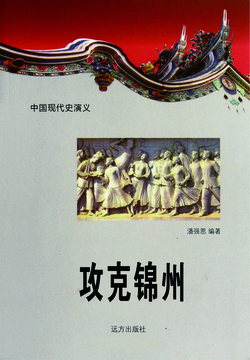
Capturing Jinzhou
Tags
Summary
Editor's review
However, it must be noted that, as a military history book published by a particular press, its perspective and selection of sources bear distinct marks of its time. Readers should understand it within its specific historiographical context. The narrative focuses on military operations themselves, with relatively limited attention to the broader social and historical background and the multidimensional impact of war. Its style leans toward documentary record with little literary embellishment, which is both a strength as a historical work—providing a relatively reliable sequence of events—and a possible barrier for readers seeking strong storytelling and emotional impact. Overall, this is a work that helps readers anchor a specific coordinate in that tumultuous history; its value lies in laying out facts and dissecting strategy and tactics rather than literary elevation.
Who it's for
A good fit for
- Military history enthusiasts with a strong interest in the history of the Chinese Civil War, especially the Liaoshen Campaign
- Readers who wish to understand the specific process and command details of a large-scale assault
- Readers of history who prefer source-based reconstruction of events over novelistic dramatization
- Researchers or students seeking to understand the strategic turning point of the Civil War through a specific battle
Not a good fit for
- Readers of fiction seeking highly literary, strongly plotted epics of personal fate
- Readers expecting diverse historical perspectives and in-depth analysis of war's social impact
Reading tips
- It is advisable to first gain a basic understanding of the overall background of the Liaoshen Campaign and the positions of both sides before reading, so as to better grasp the strategic significance of the Battle of Jinzhou
- Reading with maps, especially maps of Northeast China and the terrain around Jinzhou, helps in understanding attack and defense deployments and the course of battle
- While reading, pay attention to the descriptions of decision-making by commanders such as Lin Biao and Luo Ronghuan to appreciate the complexity of command art in large-scale corps operations
About the publisher
Yuanfang Publishing House focuses on Chinese-language publishing while also issuing books in Mongolian and other ethnic-minority scripts. Its scope covers ethnology, ethnic history and ethnic culture and arts, extending to history, economics and lifestyle titles. Among the 78 books in the database, popular science and history titles account for a large share: the former include The Mysteries of Mathematics, Physics and Chemistry and Mysteries of Unknown Knowledge, while the latter include The Long March, The Liberation of Tibet and The Founding Ceremony of the PRC. Biography and military titles such as Wang Jingwei's Dream of Leadership, Defending Yan'an and The Huaihai Campaign reflect a direction toward popular historical narrative and knowledge dissemination. Representative authors include Wang Shunyi and Pan Qiang'en, who mainly contribute to science and history writing. Overall, drawing on the regional culture of Inner Mongolia, the publisher has developed a profile that balances ethnic studies, historical documentary writing and science popularization.
Contents
- 西柏坡较量南京
- 泉城八月十五日
- 吴化文阵前倒戈
- 紧急旅行在胶东
- 挥师南下北宁线
- 上海滩后院起火
- 锦州活捉范汉杰
- 塔山鏖战胜强敌
- 东野将士围长春
- 决意迈出关键步
- 白山黑水响惊雷
- 郑洞国兵败投降
- 会战前夜各定计
- 誓与黑山共存亡
- 廖耀湘束手就擒
- 仓惶撤出东三省
- 兵进沈阳见白旗
- 在美龄号专机上
- 危机深重国统区
- 金像气煞大总统
- 油尽灯枯文胆碎
- 半生参议作侍臣
- 大军通过黄泛区
- 西柏坡运筹帷幄
- 南下大军滚洪流
- 存亡皆在此一举
FAQ
Are the historical sources in this book reliable?
Is the portrayal of the Nationalist army objective?
Will non-military enthusiasts find it difficult?
Related on WeRead
 中国现代史演义:攻克锦州
 第二十三卷·攻克锦州
 大决战:四野征战实录(1946-1950)
 解放战争:决战(全六册)
 决战:东北解放战争1945~1948
 决战:毛泽东、蒋介石是如何应对三大战役的
 《纵横》30年典藏:全52册
Comments
Find this book
This site is an index: you start “Search all sources” in your browser, and the entries it lists all point to third-party sites; please judge their availability yourself.
About the author
Pan Qiang'en (born September 1944) is a native of Bao'an, Guangdong (present-day Shenzhen). A member of the Communist Party of China and of the Chinese Writers Association, he worked for many years at the grassroots level, serving as secretary of the Party branch of Wanfeng Village in Shenzhen and as chairman of Wanfeng (Group) Co., Ltd. He founded the theory of "joint ownership" and the "Wanfeng model," and is the author of 12 scholarly works on social science, including On Joint Ownership; in 1995 he was named a National Model Worker. Beyond his academic and social practice, he also writes on historical subjects. The library holds 26 of his works, including The Long March, The Liberation of Tibet, The Founding Ceremony of the People's Republic, Defending Yan'an, The Huaihai Campaign, The Hundred Regiments Offensive and The Northern Expedition, most of which fall under history, biography and military studies. These works take revolutionary history and major campaigns as their narrative thread, interweaving historical facts with the fates of individuals in plain language, and are aimed at general readers interested in modern Chinese military and political history.
