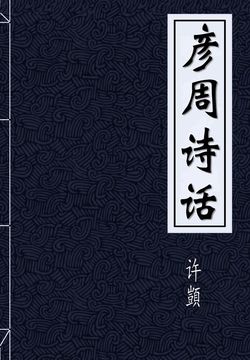
Yanzhou's Poetry Talks cover

Yanzhou's Poetry Talks

Rating 3.7
Word count
13K words
Chapters
3

Tags

Summary

Traditional Chinese thought has a long history and is highly original, inventive, and literary. Early intellectual forms are distinctive: religious theology, classical Chinese medicine, ancient military strategy, Confucianism, Daoism, Buddhism, and the Hundred Schools, feng shui and metaphysics, the Twenty-Four Histories, customs and local gazetteers—all are profound and extensive. This "Essence of the Chinese Classics: Original Texts" series preserves the original appearance of each work, emphasizing the preservation and transmission of traditional Chinese thought and culture. By reading the literary essence left by ancient sages, readers cultivate character and quietly absorb the classics.

Editor's review

The Yanzhou shihua (Yanzhou's Remarks on Poetry) is a work of poetry criticism written by Xu Yi of the Song Dynasty and belongs to the branch of classical poetics that emphasizes anecdote and evaluation. This edition is included in the "Essence of the Chinese Classics: Original Texts" series, preserving the original appearance of the text and emphasizing the preservation and transmission of traditional thought and culture. Its value lies in recording, in essay-like entries, anecdotes about poets, the merits and flaws of poetic lines, and critical opinions; its language is concise, and it offers a glimpse of Song Dynasty poetry discussion and aesthetic orientation. It should be read as notes on poetry rather than as systematic theory—flip through it at leisure, savor the entries, and read them alongside works by the Tang and Song poets discussed to better appreciate the pleasure of its judgments. It suits readers interested in classical poetics, Song Dynasty texts, and original classics for slow reading, and also serves as introductory material for understanding the genre of shihua; because it is not a modern annotated translation, beginners need some foundation in classical Chinese.

Who it's for

A good fit for

  • Readers interested in Song Dynasty shihua and classical poetics
  • Those with some foundation in classical Chinese who enjoy reading original classics
  • Students of classical literature using it as reference material on shihua
  • Readers who wish to understand Song Dynasty poetry discussion through essay-like entries

Not a good fit for

  • Beginners with weak classical Chinese who need vernacular annotation
  • Readers expecting a systematic textbook of poetic theory
  • Those who want only modern anthologies or scholarly monographs

Reading tips

  1. Read through once first, mark entries involving poets you know, then return to savor them.
  2. Read alongside the original works of the Tang and Song poets discussed to grasp what the judgments refer to.
  3. Take notes on striking critical remarks in notebook form to build your own shihua jottings.
  4. When encountering allusions or names, consult reference works first to avoid misreading and then skipping over them.

Contents

  1. 版权信息
  2. 彦周诗话
  3. 彦周诗话正文

FAQ

Can I read Yanzhou shihua without a foundation in classical Chinese?
You can try, but it will be rather difficult. This book preserves the original appearance of the text and is not a vernacular annotated translation; the entries involve many allusions and names. It is advisable to prepare a dictionary of common classical Chinese characters and read alongside works by the poets discussed. If you only want to understand the shihua genre, you may begin with a modern anthology and then return to the original.
Is this a systematic work of poetic theory?
No. The shihua genre consists mostly of random notes; Yanzhou shihua focuses on anecdote, evaluation, and appreciation, and its entries are not necessarily tightly systematized. It is best read by browsing and savoring, as notes on poetry by a Song writer, rather than as a textbook offering a complete theoretical framework.
Must the book be read in order from beginning to end?
No. The entries are relatively independent and can be read selectively according to interest. It is advisable first to browse the table of contents or flip through at random, then read closely when encountering familiar poets or lines and take notes; after a full read, return and connect them for better results.
Does reading this book help in understanding classical poetry?
It helps, but in a supplementary way. The critical remarks offer a Song Dynasty perspective on appreciation and help in grasping the merits and flaws of lines and their creative background; however, they do not replace the original poems and annotated editions. It is best to make the original poems primary and the shihua secondary, reading them together to understand what the remarks specifically refer to.

Related on WeRead

Comments

Find this book

This site is an index: you start “Search all sources” in your browser, and the entries it lists all point to third-party sites; please judge their availability yourself.

About the author

许顗 Author

Xu Yi was a Song-dynasty writer on poetry, but his life is now obscure: his nationality and dates of birth and death cannot be verified, and available public information is limited, so his poetic views can only be understood through his surviving works. The library currently holds two works by him, both related to Yanzhou Shihua (Yanzhou's Remarks on Poetry), including a copy titled "Yanzhou Shihua - Song - Xu Yi" and Yanzhou Shihua itself. Written in the form of miscellaneous notes, the book comments on poets and poems of successive dynasties and records anecdotes and allusions from the poetry world. It values ideas, diction, and prosody, and pays attention to the polishing and merits of individual lines. Its style is concise and focused on the appraisal of specific works, offering some reference value for the study of Song-dynasty poetics and the atmosphere of poetic criticism. Beyond this work, further research is needed on Xu Yi's life and other writings.

More by the same author

Top rated in the same category