

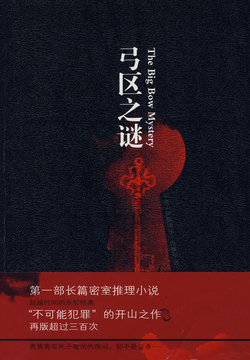
The Big Bow Mystery
Tags
Summary
Editor's review
Who it's for
A good fit for
- Lovers of classical detective fiction and locked-room puzzles who want to trace the genre to its origins
- Readers interested in the history of detective fiction and in the appeal of Thorndyke, the founding scientific detective
- Fans of honkaku deduction who prefer logical reasoning to psychological portraiture
- Readers who can appreciate plain prose and solid structure without demanding dramatic twists
Not a good fit for
- Modern suspense readers seeking fast pacing, strong sensory thrills, or social-depth themes
- Readers expecting intricate, astonishing tricks or multiple reversals—the book's core value lies in pioneering, not complexity
Reading tips
- Try to set aside every later locked-room convention and read it as 'the first case,' experiencing the original shock
- Pay attention to how Dr. Thorndyke uses the scientific knowledge of his day (microscopy, chemical analysis) to gather evidence—one of the book's hallmarks
- Afterwards, if interested, read locked-room works by later writers such as John Dickson Carr and sense how the genre evolved
About the publisher
New Star Press focuses on classic works, mystery and detective fiction, science fiction, history, foreign literature and art, and its 602 titles in the library show a balance between popular reading and humanistic depth. Representative books include The Complete Works of Shakespeare: Illustrated Collector's Edition, And Then There Were None, Murder on the Orient Express, The Player of Games, Local Government in Qing China, A Good Man Is Hard to Find and A Collection of Fine Ukiyo-e Prints, spanning classic literature, detective fiction, science fiction, local history and visual art. Its authors and contributors include William Shakespeare, Agatha Christie and Iain M. Banks, as well as translators such as Zhu Shenghao and Su Fuzhong and illustrators such as John Gilbert and George Cruikshank. Known for the detective series Midnight Library and for social-science and humanities titles, the press emphasizes edition design and reading experience; public information is limited, so this profile highlights the publishing features reflected in the library's books.
Contents
- 版权信息
- 《弓区之谜》 密室推理的“福音书”
- 一
- 二
- 三
- 四
- 五
- 六
- 七
- 八
- 九
- 十
- 十一
- 十二
FAQ
What is this book's Douban rating?
What other notable works did Israel Zangwill write?
Is the book difficult to read?
Related on WeRead


Comments
Find this book
This site is an index: you start “Search all sources” in your browser, and the entries it lists all point to third-party sites; please judge their availability yourself.
About the author
Israel Zangwill is an author about whom relatively little biographical information is available; his nationality, dates of birth and death, and full educational background are difficult to establish with certainty. What can be confirmed is that one of his works, The Mystery of the Bow District, has been translated into Chinese and classified under foreign literature. Judging from the title and the common category, the work appears to have elements of suspense or mystery, possibly centering on an enigma in a closed neighborhood and emphasizing atmosphere and plot development. Zangwill's writing style may lean toward using everyday settings as a backdrop, planting doubts within seemingly calm neighborhood life and drawing readers forward through detailed description and suspense. Although more historical material is needed to fill out his personal history and the full scope of his writing, the existence of this work at least shows that he took part in narrative literature and offers Chinese readers a window into his creative profile.
Chen Jie was born in Hangzhou in 1983. He holds a master's degree in Sino-Japanese exchange history from Zhejiang University and currently works in the research department of a museum in Hangzhou, where he is engaged in curation and writing on Japanese history and culture. Public information about him is limited, so little more can be confirmed about his personal background. His works and common categories nonetheless show interests spanning several fields: he has written on Japanese history and culture, including a trilogy on the history of Japan's Warring States period, the Meiji Restoration and the shogunate era, as well as works on postwar Japan and the world of the Shosoin, and has also touched on medicine, foreign literature, mystery and detective fiction, and social novels. His writing is known for its careful use of historical sources and cultural interpretation, aimed at general readers and seeking a balance between expertise and readability.
