

Zhuangzi: Outer Chapters (1)
Tags
Summary
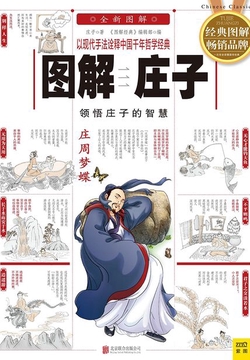
Writing from the perspective of an ordinary citizen, the author re-annotates and reinterprets the Outer Chapters in order to carry forward traditional culture, spark readers' reflection, and help the classic's content take deeper root in their minds.
Centered on "rectifying the mind and cultivating the self," with improving one's cultivation and examining social phenomena as its thread, the book interprets the text chapter by chapter and passage by passage. It seeks to link theory with practice, to open up and stimulate readers' thinking, and so to foster an exchange of views that reaches the highest level together. Its apparatus includes the original text, annotations and analysis, brief introductions to the figures mentioned, translation, cited commentary from successive dynasties, and reading notes, all designed to make the book easy to read and to help readers connect it with reality, apply what they learn, and improve their cultivation.
Editor's review
Who it's for
A good fit for
- Ordinary readers interested in Zhuangzi but intimidated by the difficulty of the original text
- Office workers who hope to use traditional classics to adjust their mindset and cultivate body and mind
- Beginners in the Chinese classics who need passage-by-passage understanding of the Outer Chapters
- Slow readers who like the composite format of original text plus annotations plus reading notes
Not a good fit for
- Professional researchers seeking rigorous scholarly textual criticism and collation of editions
- Readers who want only vernacular stories and do not wish to engage with the original text and annotations
- Readers expecting a systematic theoretical construction of Zhuangzi's philosophy
Reading tips
- Read the translation first to grasp the general meaning, then go back to the original text and annotations, and finally read the notes to connect with reality.
- Read slowly in the order of the Outer Chapters; after each chapter, leave a little time to reflect on it in light of your own situation.
- When you encounter cited commentary from successive dynasties, treat it as further leads; there is no need to memorize it—pick the comments that interest you and read them closely.
- Keep a pen at hand and write your own questions and associations with daily life in the notes section for later review.
Contents
- 版权信息
- 外篇
- 骈拇
- 马蹄
- 胠箧
- 在宥
- 天地
- 天道
FAQ
Can I read this book without any grounding in classical Chinese?
What is the difference between the Outer Chapters and the Miscellaneous Chapters, and should they be read in order?
What is the role of the cited commentary from successive dynasties and the reading notes?
Related on WeRead



Comments
Find this book
This site is an index: you start “Search all sources” in your browser, and the entries it lists all point to third-party sites; please judge their availability yourself.
About the author
Liu Qiang, born in Suqian, Jiangsu in 1966, is a Chinese publisher and planner of educational supplementary books and currently general manager of Beijing Beijiao Culture and Media Co., Ltd. Since 1989 he has edited the "Middle School English Study Guide" series and has planned and edited supplementary series such as "1+1 Lightweight Champion," "Classroom Live," and "Key Exam Points," with cumulative distribution exceeding 400 million copies. The library holds 64 of his works, which beyond supplementary publishing also touch on literary appreciation, Eastern philosophy, medicine, culture, and industrial technology; representative works include editions and selections of "A New Account of Tales of the World" and the inner, outer, and miscellaneous chapters of "Zhuangzi." Public information is limited, but the available works indicate an editorial orientation combining educational publishing with the popularization of traditional culture, with selections emphasizing the organization and guided reading of classic texts while balancing practicality and readability.
