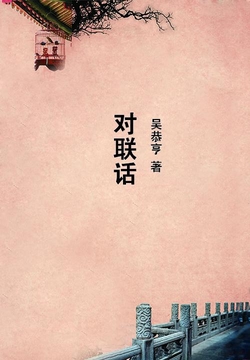
Remarks on Couplets cover

Remarks on Couplets

Rating 3.5
Word count
223K words
Chapters
15

Tags

Summary

Traditional Chinese culture has a long intellectual history and is highly original, inventive, and literary. Early thought forms are distinctive: religious theology, classical Chinese medical texts, ancient military strategy, Confucian, Daoist, Buddhist, and Hundred Schools thought, feng shui and metaphysics, the Twenty-Four Histories, and local customs and gazetteers are all profound and extensive. This series, "Essence of Classic Chinese Culture: Original Texts," preserves the original appearance of the books and focuses on preserving and transmitting traditional Chinese thought and culture. By reading the literary essence left by ancient sages, readers cultivate character and imperceptibly encounter the classics of Chinese learning.

Editor's review

Duilianhua, by Wu Gongheng, belongs to the series "Essence of Classic Chinese Culture: Original Texts," whose aim is to preserve the original appearance of the books and transmit traditional thought and culture. Couplets are a genre of traditional Chinese literature that combines practical use with artistry, emphasizing parallelism, tonal patterns, and mood; works in the "hua" (remarks) style typically record couplets, assess their merits, and recount anecdotes in informal notes, offering both information and pleasure. The book's value lies in giving readers direct access to traditional remarks on couplets, letting them feel how people in earlier times appreciated, evaluated, and used couplets, and catching a glimpse of traditional literary criticism and local customs. Read it as casual reading: there is no need to plow through it from cover to cover. Open at any couplet and savor the cleverness of its parallelism and the depth of its intent, and the charm of traditional language becomes more palpable. For readers who want to understand couplet culture and accumulate literary material, the book offers authentic reference; but those expecting a systematic textbook on how to write couplets will need a separate introductory guide.

Who it's for

A good fit for

  • Readers interested in couplet and duilian culture who want to encounter original texts
  • Literature lovers with some classical Chinese who enjoy note-and-jottings reading
  • Chinese teachers and writing enthusiasts who need traditional couplet material
  • General readers interested in traditional literary criticism and local anecdotes

Not a good fit for

  • Complete beginners with no classical Chinese who need line-by-line vernacular explanation
  • Readers seeking a systematic couplet-writing course and metrical exercises
  • Researchers who prefer modern academic frameworks and demand rigorous theoretical structure

Reading tips

  1. Keep the book at hand for casual reading; browse a few entries at a time and savor the parallelism and intent.
  2. Keep a notebook, jot down favorite couplets, and try imitating one or two.
  3. Mark unfamiliar allusions or names and look them up later in a batch, so the reading rhythm is not broken.
  4. Read alongside an introductory book on couplet meter: appreciate the couplets first, then learn the rules, and understanding will be more concrete.

Contents

  1. 版权信息
  2. 卷一 题署一
  3. 卷二 题署二
  4. 卷三 题署三
  5. 卷四 题署四
  6. 卷五 庆贺
  7. 卷六 哀挽一
  8. 卷七 哀挽二
  9. 卷八 哀挽三
  10. 卷九 哀挽四
  11. 卷十 哀挽五
  12. 卷十一 杂缀一
  13. 卷十二 杂缀二
  14. 卷十三 杂缀三
  15. 卷十四 谐谑

FAQ

Is Duilianhua a textbook that teaches people how to write couplets?
Judging by the title and the conventions of traditional "hua"-style works, it is more a collection of notes that records and evaluates couplets and related anecdotes than a systematic metrical textbook. Readers can learn from it how earlier people appreciated and critiqued couplets, but to systematically master tonal and parallelism rules, it is advisable to use a separate introductory couplet primer alongside it.
What level of classical Chinese is needed to read this book?
Basic reading ability in classical Chinese is needed, enough to understand common classical words and allusions with the help of reference works. The book preserves the original appearance and has no line-by-line vernacular translation, so readers with weak classical Chinese will find it hard going. Start with short couplets and gradually adapt with a dictionary and annotated editions.
Is this book suitable for reading straight through from beginning to end?
There is no need to insist on reading it straight through. Works in the remarks-on-couplets style are mostly individual notes whose connections are not necessarily tight, so it suits browsing and savoring entry by entry. Readers can skip around by interest or read a few entries a day and copy out favorite couplets; this makes it easier to appreciate the interest and craft than reading it all at once.
How does the content differ from other Chinese classics in the series?
This book focuses on the specific literary genre of couplets, mainly couplets and evaluations, so its theme is more concentrated than series volumes covering classics, history, the various philosophers, and gazetteers. It lets readers enter through couplets and feel the beauty of parallelism in traditional language and ways of literary criticism, making it suitable as topical casual reading.

Related on WeRead

Comments

Find this book

This site is an index: you start “Search all sources” in your browser, and the entries it lists all point to third-party sites; please judge their availability yourself.

About the author

吴恭亨 Author

Wu Gongheng is an author whose birthplace, dates of birth and death, and other biographical details are not widely documented in public sources. The information currently available identifies him chiefly as a writer associated with the creation and criticism of Chinese couplets (duilian). His representative work, Dui Lian Hua, is a book devoted specifically to couplet writing; it discusses compositional methods, formal conventions, and the appraisal of individual works, combining literary criticism with documentary value, and is frequently cited in research on couplets. What can be gathered suggests that his writing centers on the traditional art of parallelism, emphasizing craftsmanship, emotional resonance, and artistic conception in the works themselves rather than merely recounting anecdotes. A work of this kind is useful for later readers seeking to understand the aesthetic standards and creative approaches of the couplet as a literary form. Owing to the lack of reliable biographical material, this introduction offers no speculation about his life and confines itself to the verifiable work and its classification within the collection.

Top rated in the same category