

A Guest's Account of Yunnan
Tags
Summary
Editor's review
Who it's for
A good fit for
- Researchers of Ming–Qing history and Yunnan local history who need to compile rare notebook sources
- Readers of history and literature interested in frontier society at a time of dynastic change
- Readers who enjoy the ancient notebook genre and are used to fragmented reading
- Compilers of local gazetteers and textual editors, who may use it as corroborating material
Not a good fit for
- Ordinary fiction readers expecting a continuous plot and character development
- Beginners without historical background who would need a guide to read it
- Readers seeking a systematic general history rather than scattered notes
Reading tips
- Read the preface or editorial notes first to understand the background of the book and its textual editions, then move on to the main text.
- Keep a historical map of Yunnan and a Ming–Qing chronological table at hand to check place names and dates as you read.
- Excerpt entries by theme—customs, military affairs, people—for easier retrieval and citation later.
- Read it alongside related contemporary histories and gazetteers of Yunnan, noting differences between the notebook's accounts and official records.
About the publisher
Nanhai Publication Company is a comprehensive publisher known for its literature and arts titles, covering fields such as classical poetry, martial arts fiction, and folk literature. Judging from the more than 1,600 books in the database, the company has released classical poetic works including the Nineteen Old Poems and the Nine Songs, as well as multiple volumes of Huanzhulouzhu's series The Swordsmen of Mount Shu, along with related writings by authors such as Guan Hanqing, Qu Yuan, Zuo Si, and Wang Zhihuan. Its publishing character lies in balancing the organization of classic texts with the dissemination of popular literature, placing poetry anthologies alongside long martial arts novels and presenting a relatively diverse literary profile. Public information is limited, and further details about its editorial practices and series planning remain to be supplemented.
Contents
- 版权信息
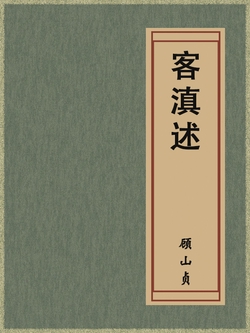
- 客滇述
FAQ
Is this book a complete general history of Yunnan?
Can I understand it without a historical background?
Should I take notes while reading?
Is this book suitable as a source for research citations?
Related on WeRead



Comments
Find this book
This site is an index: you start “Search all sources” in your browser, and the entries it lists all point to third-party sites; please judge their availability yourself.
About the author
Yun Jian Gu Shanzhen: little is known about this author, as no clear records survive regarding his life, native place, or identity, and the available public information is limited, making it difficult to sketch a complete biographical outline. Among his extant works is one title, Ke Dian Shu (An Account of Sojourning in Yunnan), which is commonly classified under folk literature. The work takes the observations of a sojourner in Yunnan as its thread and has the character of recording local customs and social conditions, written in a plain, natural style close to folk narrative and attentive to documenting and retelling everyday life in Yunnan. Given the scarcity of materials on the author, the work is all the more valuable: it offers readers a readable text for understanding the folk life of the region and preserves Yun Jian Gu Shanzhen's name in bibliographic records through Ke Dian Shu, making it a concrete example for the study of folk literary writing.
