

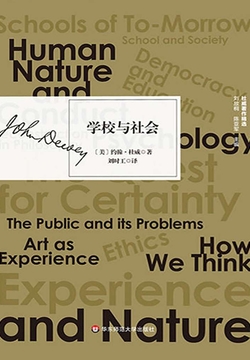
The School and Society
Tags
Summary
Editor's review
Who it's for
A good fit for
- Researchers and learners interested in educational philosophy and the history of education
- Frontline educators, especially teachers seeking to renew teaching concepts and innovate in practice
- Parents concerned with children's all-round development and hoping to understand the essence of education
- Readers who think about sociology, democratic theory, and paths of social improvement
Not a good fit for
- Readers seeking concrete, immediately applicable classroom teaching manuals
- Readers expecting light recreational reading
Reading tips
- It is suggested to first read Dewey's Democracy and Education or My Pedagogic Creed to establish a preliminary framework of his thought system before delving into this book.
- While reading, compare it with your own educational experience or observed educational phenomena to understand the specific targets of Dewey's critique.
- Focus on the discussion of core concepts such as "interest," "experience," and "growth," which are key to understanding Dewey's educational thought.
About the publisher
Adhering to the publishing purpose of "broad education," East China Normal University Press extends beyond its three main areas of textbooks, academic works and general-interest books, and its catalogue clearly reflects a vision that bridges Chinese and foreign humanities and social sciences. In foreign literature it offers classics such as Yasunari Kawabata's Snow Country and The Old Capital (translated by Chen Dewen), Jane Austen's Pride and Prejudice, and Rilke's annotated edition of The Notebooks of Malte Laurids Brigge (translated by Chen Zao); in architecture, Chen Congzhou's two-volume Appreciation Dictionary of Chinese Gardens; in social psychology, The Social Animal: 12th Edition; and it also includes philosophy titles, traditional-culture works such as the six-volume Paintings for the Protection of Life, and education books. Its authors include renowned Chinese and foreign writers and skilled translators, showing a publishing profile that balances classic translation, scholarly accumulation and public reading. Public information is limited; the above is based only on the books in the catalogue.
Contents
- 版权信息
- 主编序
- 出版者说明
- 作者说明
- 第一章 学校与社会进步
- 第二章 学校与儿童生活
- 第三章 教育中的浪费
- 第四章 大学初等学校的三年
- 第五章 初等教育心理学
- 第六章 福禄培尔教育原理
- 第七章 关于作业的心理学
- 第八章 注意力的发展
- 第九章 初等教育中历史教学的目标
- 修订版译后记
FAQ
What is the difference between this book and Dewey's Democracy and Education?
Are the views in the book still applicable today?
Is this book suitable for readers without a background in education?
Related on WeRead


Comments
Find this book
This site is an index: you start “Search all sources” in your browser, and the entries it lists all point to third-party sites; please judge their availability yourself.
About the author
John Dewey (1859–1952) was an American philosopher, educator, and psychologist, the leading figure of pragmatism and one of the important founders of functionalist psychology and modern education. He held that education is life and that learning comes through doing, advocated a child-centered approach, and stressed the role of experience and action in knowledge and growth—a thread running through his philosophical and educational writing. The library holds 22 of his works, covering social culture, education, social science, Western philosophy, philosophy readers, and social psychology. Representative works include Democracy and Education, Art as Experience, Experience and Nature, The Public and Its Problems, How We Think, and Human Nature and Conduct. His writing is clear and practical, grounding abstract theory in everyday experience and public life. His lectures in China in 1919 had a lasting influence on Chinese education in the twentieth century.
Liu Shigong is an author about whom limited public information is available; the verifiable material currently centers on a single work, School and Society. The book is classified under education, indicating that his writing concerns the relationship between schooling and society and belongs to a basic discussion of educational issues. Because no clear records exist regarding his dates of birth and death, nationality, education, or professional career, no further account of his life can be given, nor is it possible to determine whether his writing extends into other fields. On the evidence of the existing work, Liu Shigong writes on educational questions, with emphasis on the interaction between school institutions and the social environment, and his style is likely expository and reflective rather than narrative or lyrical. Such subject matter generally appeals to educators, researchers, and general readers interested in the relationship between education and society. Readers who wish to understand his views may begin with School and Society, though more public material is still needed to complete the picture of the author and his thought.
