

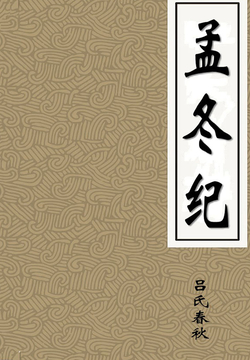
Record of the First Month of Winter
Tags
Summary
Editor's review
Who it's for
A good fit for
- Readers of literature and history interested in pre-Qin philosophers and syncretic thought
- Scholars who need to study monthly ordinances and ancient conceptions of the seasons
- Supplementary reading for university courses in classical Chinese literature and ancient history
- Readers who enjoy short fables combined with political discourse and prefer fragmented reading
Not a good fit for
- Beginners seeking plain-language stories or light entertainment
- Those without a foundation in classical Chinese who need sentence-by-sentence modern translation
- Specialist researchers expecting systematic theory from a single school
Reading tips
- Read the monthly ordinance section first to grasp the seasonal framework of the whole piece, then move on to the discursive chapters.
- Keep a critical edition of the Lüshi Chunqiu at hand to look up rare characters, terms, and institutions as you read.
- Extract passages on life and death and on integrity, and compare them with other records in the same book.
- After each chapter, summarize its main point in your own words rather than stopping at literal explication.
About the publisher
Jinzhang Book Company (Jinzhang Shuju) was a private publishing and distribution house in Shanghai during the late Qing and early Republican periods, issuing traditional works by lithographic printing. Judging from the 1,194 titles in the collection, its publishing focused on classical poetry, Eastern philosophy, historical reading, traditional Chinese medical texts, and canonical works, along with books on literary appreciation. Representative titles include the poetry and prose collections of Du Fu and Ouyang Xiu; historical works such as the Book of Han and Zizhi Tongjian; classical texts such as the Book of Documents and Mencius; and specialized and literary classics such as Treatise on Cold Damage and Li Sao. Its author resources cover major figures across the ages, including Du Fu, Ban Gu, Sima Guang, Zhang Zhongjing, Qu Yuan, Ouyang Xiu, and Tang Shenwei, reflecting the house's characteristic reliance on traditional scholarship and medical literature while serving general readers. Public information on its early history and operational details is limited, so no conjecture is offered here.
Contents
- 版权信息
- 序
- 孟冬
- 节丧
- 安死
- 异宝
- 异用
FAQ
Is "The Record of the First Month of Winter" a standalone work?
Can I read it without a foundation in classical Chinese?
Why does the book contain doctrines of so many schools?
Should this record be read alongside other chapters?
Related on WeRead





Comments
Find this book
This site is an index: you start “Search all sources” in your browser, and the entries it lists all point to third-party sites; please judge their availability yourself.
About the author
Lüshi Chunqiu is not a single author but a work compiled under the direction of Lü Buwei, the chancellor of Qin in the late Warring States period, and it is commonly cited under the name "Lüshi Chunqiu." Publicly available information about the individual compiler's life is limited, and no exact dates of birth or death or nationality are recorded. The book is broad in scope, gathering materials from the various schools of pre-Qin thought and covering subjects such as astronomy, calendars, ritual institutions, politics, and ethics. The works listed in the catalog, such as the Annals of Midsummer, Early Summer, Early Spring, Midsummer, Early Winter, Late Spring, Late Autumn, and the Discourses of the Opening of Spring, are chapters arranged by season and month, reflecting a style organized around the seasons and integrating the doctrines of the Hundred Schools. The book is often mentioned in cultural and Eastern philosophy categories and is an important source for understanding pre-Qin thought and the concept of monthly ordinances.
