

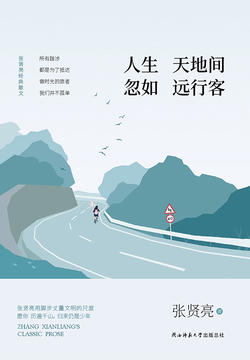
A Wayfarer in Heaven and Earth
Tags
Summary
This book is also a great book of truth-telling about life. "Great" here refers to a broad vision and a lofty realm. Though the author weathered many hardships, he never lost his childlike heart. In his later years, he saw people and affairs with remarkable clarity, and he had both the courage and the skill to express himself. Sincere, earnest, and incisive—these three words may best sum up the backbone of his writing. These pearl-like philosophical reflections spark our thinking and help us fully appreciate his personal charisma.
On this very long road, I have walked broad highways and narrow single-plank bridges. Beside the road lie deep mountains and vast marshes, but also gentle level slopes; there are apricot blossoms in spring rain, and autumn winds on the northern frontier; there are repeated mountains and winding waters, and also willows and bright flowers; there are lost paths found again, and escapes from dead ends. May everyone attain the open-hearted outlook of "drifting through great waves, neither joyful nor fearful. When it is time to end, let it end; do not brood overmuch."
Editor's review
Who it's for
A good fit for
- Readers who enjoy short aphorisms and want casual inspiration
- Readers interested in Ji Xianlin's thought and character who want a selected volume first
- General readers facing life's confusions and seeking a broad-minded reference
- Readers interested in traditional culture and comparisons between Chinese and Western cultures
Not a good fit for
- Readers expecting a systematic academic treatise or a complete intellectual system
- Readers who prefer long narratives and strongly plotted works
- Readers who hope this book can replace Ji Xianlin's original works
Reading tips
- No need to read from cover to cover; skip by theme, reading a few passages a day and pausing briefly.
- When something resonates, jot down your questions and then consult Ji Xianlin's original books for deeper study.
- Alternate between the sections on reading and scholarship and on the human condition to see how they echo each other.
- After finishing, choose one or two themes and return to Ji Xianlin's originals so as not to stop at a selected volume.
Contents
- 版权信息
- 致读者
- 第一章 天地一行客
- 四季感怀
- 燕园幽思
- 履痕处处
- 生命冥想
- 第二章 怀旧净化灵魂
- 永远的母亲
- 授业恩师
- 大师肖像
- 后死者之痛
- 第三章 谈佛论道
- 信仰
- 文化交流
- 智慧
- 天国入门券
- 第四章 西方不亮东方亮
- 东方西方
- 天人合一
- 中华文化的特性
- 美的差异
- 文论有别
- 德国态度
- 第五章 坏人不会改好
- 善与恶
- 厚·黑·大
- 可怕的遗忘
- 坏人的本领
- 地狱里的形状
- 劣根性种种
- 浮躁的文化人
- 第六章 没有真情不动笔
- 我的文学观
- 我爱太白和东坡
- 文学的意味
- 写作者须知
- 第七章 知识分子的阴影
- 教授架子
- 一流大学的条件
- 北大和清华
- 学术良心
- 文人的气节
- 爱国成性
- 第八章 不完满才是人生
- 幻想救世主
- 爬格子的价值
- 信念所怀
- 一真二忍
- 我看我
- 衣食所安
- 人生只有一条路
- 面对死亡
FAQ
Is this book compiled by Ji Xianlin himself?
Does the aphorism format make the book feel fragmented?
What age group is this book suitable for?
Related on WeRead


Comments
Find this book
This site is an index: you start “Search all sources” in your browser, and the entries it lists all point to third-party sites; please judge their availability yourself.
About the author
Ji Xianlin (1911–2009) was a Chinese orientalist, Indologist, Sanskrit scholar and translator, and a senior professor at Peking University. He was versed in Sanskrit, Pali and Tocharian, and served as vice president of Peking University and director of the Institute of South Asian Studies at the Chinese Academy of Social Sciences. His long engagement with Indology and cultural exchange produced works such as The Track of Cultural Exchange: A History of Sugar Cane in China, which traces civilizational contact through a single commodity, while his translation of the Panchatantra brought an Indian classic to Chinese readers. He is equally noted for his essays, several selections of which appear in this catalog; they dwell on hometown scenery, old friends and teachers, and everyday reflections in a plain, unhurried style that reveals warmth and erudition in small details. His works are commonly grouped under culture, classic works, essays and miscellaneous writings, and foreign literature. The catalog currently holds seventy-four titles, appealing to both scholarly and general readers.
Lao Yu: public information about this author is limited. All that is currently known is that nine of the author's works are held in the collection, with representative titles including Tian Di Yi Xing Ke (A Traveler Between Heaven and Earth) and volumes 1 to 4 and 6 to 8 of the Dongfang Juan (Eastern Volume) series. These works are commonly classified under inspirational growth, suggesting that the writing centers roughly on personal development, cultivation of character, and reflections on life. The title Tian Di Yi Xing Ke carries connotations of travel and of finding one's place, while the Dongfang Juan series unfolds its content in multiple volumes on a fairly considerable scale, suiting readers who prefer to proceed volume by volume. Because exact details such as dates of birth and death, nationality, and educational background are unavailable, the author's life story cannot yet be described in detail; readers may instead begin with the works themselves and appreciate their plain, introspective mode of expression, grasping the author's focus and overall profile through subject matter and arrangement.
