

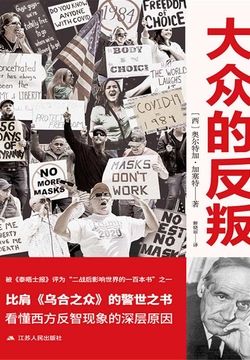
The Revolt of the Masses
Tags
Summary
Editor's review
Who it's for
A good fit for
- Deep readers interested in political philosophy and social theory
- Thinkers seeking to understand the inherent dilemmas of modern democratic society
- Cultural researchers concerned with the tension between mass culture and elite culture
- Students of literature and history exploring the intellectual currents of the twentieth century
Not a good fit for
- Casual readers expecting light, accessible fare
- Readers impatient with abstract theoretical argument
Reading tips
- Readers may first consult a biography of the author or background on Spanish intellectual history to grasp the book's historical context
- Read in dialogue with Le Bon's The Crowd and Arendt's The Origins of Totalitarianism
- Take notes to map the author's core concepts—"the masses," "hyperdemocracy," "barbarism"—and understand his distinctive definitions
About the publisher
Beijing Times Chinese Press takes classic works and prose miscellanies as an important publishing direction, along with foreign literature, social novels, Eastern philosophy and art books. Its catalogue includes such Chinese classics as Lu Xun's Call to Arms and Wandering, Xiao Hong's The Field of Life and Death, Zhang Dai's Reminiscences of Tao'an, Yuan Mei's Recipes from the Sui Garden and Hong Yingming's Caigentan, as well as foreign classics such as Ryunosuke Akutagawa's Rashomon. Among its translator resources is Wen Jieruo, whose translations provide reliable support for bringing foreign literary works into the Chinese-speaking world. While organizing traditional texts and reissuing classics, the press pays attention to readability and accessibility of editions, enabling ancient prose, notes and philosophical works to reach contemporary readers. Public information is limited; the above is only a brief account of the publishing directions reflected in the books held in the database.
Contents
- 版权信息
- 前言
- 第一章 大众降临
- 第二章 历史水平面上升
- 第三章 时代的高度
- 第四章 生命潜力的提升
- 第五章 一项统计学真相
- 第六章 大众人研究报告
- 第七章 贵族生活和大众生活,或勤力与惰性
- 第八章 大众干预一切,并且为何暴力是其唯一的手段
- 第九章 原始与技术
- 第十章 原始主义和历史
- 第十一章 妄自尊大的时代
- 第十二章 “专业化”的野蛮主义
- 第十三章 国家:最大的危险
- 第十四章 谁统治着世界?
- 第十五章 直面真正的问题
FAQ
How does Ortega's concept of "the masses" differ from the Marxist "masses of the people"?
Does this book help in understanding group phenomena in the age of social media?
Why is this book said to transcend its specific historical context?
Related on WeRead




Comments
Find this book
This site is an index: you start “Search all sources” in your browser, and the entries it lists all point to third-party sites; please judge their availability yourself.
About the author
José Ortega y Gasset is a Spanish thinker. The Revolt of the Masses is his most representative work and, at present, the only one of his books included on this site. The book is classified as political writing. It addresses the problems that public life faces after the rise of mass society, with discussion extending to social structure and political order. Its prose shows a clear philosophical and speculative character, excelling in conceptual analysis and overall judgment rather than in the accumulation of materials. As far as publicly available Chinese-language sources are concerned, records of his life and education are quite limited, so no details are added here. What can be affirmed is that The Revolt of the Masses has long been regarded as one of the frequently cited works in twentieth-century political thought, and its discussion of the relationship between the masses and politics still offers reference value for understanding public issues in modern society.
Ma Nan, about whom limited public information is available, focuses on practical fields such as politics, finance and economics, management, examinations and construction, with five works held in the collection. Representative titles include The Revolt of the Masses, together with a series of practical books on construction cost and engineering procurement contracting pricing, such as the Application Guide to the Pricing Code for Engineering Procurement Contracting of Construction Projects, the Exam Guide and Mock Questions for Construction Measurement and Pricing Practice (Civil Engineering and Building Construction), and the Exam Guide and Mock Questions for Fundamentals of Construction Cost Management. Ma Nan also contributed to Market Research and Analysis (2nd Edition). The works combine theoretical reflection with industry practice, addressing social and political issues while serving professional study and vocational examinations in construction cost and market research, showing a cross-disciplinary, practice-oriented approach.
