

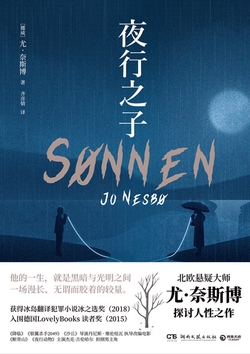
Child of the Night Walker
Tags
Summary
In his early thirties, he was once a model prisoner who had spent more than a decade in an Oslo prison.
He was the prison's "redeemer"; his cell was a confessional for the other inmates.
Sonny's calm smile seemed to have a singular healing power, drawing other prisoners to confess to him in the belief that it could wash away their sins.
He had been all but set to spend half his life behind bars, but one prisoner's confession changed everything—the man's prayers mentioned Sonny's father, the "corrupt" police officer who had once taken his own life in atonement. There seemed to be more to the story.
When Sonny learns that his life has been built on a stack of lies, he resolves to fight for his freedom—for only in freedom can he take his revenge.
The evil and corruption lurking beneath a bright Oslo drive Sonny to be reborn in an extreme form, ready to strike back with violence against violence. Yet a dangerous pursuit still stalks him at every turn...
Editor's review
The book's value lies in its profound character portrayal and its exploration of heavy themes. Harry Hole is more broken and isolated than ever in this volume; his "night walking" is both a physical pursuit of criminals and a metaphor for being mired in inner darkness and alcoholism. Nesbø is not content to tell a gripping detective story; he is more concerned with exploring the boundaries of justice, institutional corruption, personal redemption, and the hereditary nature of evil. Australia's vast, desolate landscapes form a striking intertext with the coldness of the case and the desolation of the characters' inner worlds, heightening the story's sense of fate and tragedy. For series readers, this is a key link in understanding Harry Hole's character arc; for new readers, it is equally a top-tier work of crime literature that immerses and provokes long reflection. Its Douban rating holds steady above 8.5, confirming readers' broad recognition of its literary quality and narrative power.
Who it's for
A good fit for
- Devoted fans of Jo Nesbø and Nordic crime fiction
- Readers who enjoy deep, complex, character-driven crime stories
- Literary readers drawn to themes of justice, guilt, and redemption
- Mature readers comfortable with a dark tone and heavy psychological portraiture
Not a good fit for
- Readers seeking light, fast-paced entertainment
- Readers with low tolerance for violence and grim subject matter
Reading tips
- Reading in series order is recommended, starting at least with The Bat or The Redbreast, to fully grasp the character relationships and emotional buildup.
- Pay attention to the connection between environmental description and characters' psychological states; Nesbø excels at using landscape to set mood and atmosphere.
- Be prepared for an emotional impact—the ending is immensely powerful and may take some time to process.
About the publisher
Hunan Literature and Art Publishing House is a publisher known for its literary titles, with a catalogue spanning foreign literature, world classics, classical Chinese literature, essays and miscellaneous writings, and mystery and detective fiction. Judging from the more than 1,100 books in the database, the press publishes foreign classics such as Crime and Punishment, Snow Country, The Complete Sherlock Holmes and Letter from an Unknown Woman, as well as Chinese classical and modern literary works including Lu Xun's Wandering and A Madman's Diary and Wu Jingzi's The Scholars. In terms of translators and authors, translations by Cao Guowei and Tan Jinghua appear in its foreign literature titles, and the authors involved include Dostoevsky, Kawabata Yasunari, Conan Doyle and Zweig. Its publishing character lies in introducing Chinese and foreign literary classics side by side, balancing popular and serious works and attending to both readability and literary value. Public information is limited; the above is a brief overview based solely on the books in the database.
Contents
- 版权信息
- 第一部
- 1
- 2
- 3
- 4
- 5
- 6
- 7
- 8
- 9
- 10
- 11
- 第二部
- 12
- 13
- 14
- 15
- 16
- 17
- 18
- 19
- 20
- 第三部
- 21
- 22
- 23
- 24
- 25
- 26
- 27
- 28
- 29
- 30
- 31
- 32
- 第四部
- 33
- 34
- 35
- 36
- 37
- 38
- 39
- 40
- 41
- 第五部
- 42
- 43
- 尾声
FAQ
Will reading The Night House without the earlier books affect my understanding?
Where does this book stand in the series, and how does its style differ?
How does Nesbø's writing style show in this book?
Related on WeRead



Comments
Find this book
This site is an index: you start “Search all sources” in your browser, and the entries it lists all point to third-party sites; please judge their availability yourself.
About the author
Jo Nesbø, born in Oslo, Norway, in 1960, is both a crime novelist and a musician, and is hailed as a leading figure in Nordic crime fiction. His writing is known for suspense and detective fiction, most notably the series featuring detective Harry Hole. His debut novel, The Bat, appeared in 1997, and he has continued to publish new works since, building a body of crime narratives marked by a cool tone and tightly woven plots. His works are categorized under classic works, foreign literature, and suspense and mystery, and have been published on a substantial scale in the Chinese book market in collected editions, with 22 titles held in the library, including such representative works as The Leopard, Police, Phantom, and The Night House. His books have sold more than fifty million copies worldwide and have had a broad influence.
Qi Yanjing is a Chinese book translator and author about whom limited public information is available. Seven works appear under her name in the library, spanning biography, foreign literature, and classic works. Her representative titles include the translation of I Am Malala and other biographical works, as well as translations of foreign literary works such as The Nightwalker, Awakening, I Am an Island, and Richard Yates's Revolutionary Road-era works including Fate, along with a collected edition of Richard Yates. Her work focuses on bringing overseas biographies and novels to Chinese readers, with selections balancing realistic subjects and classic literature, and her translations serving the narrative and character portrayal of the originals. As biographical details are not publicly available, her style can only be understood indirectly through these works.
