

Aliens
Tags
Summary
Editor's review
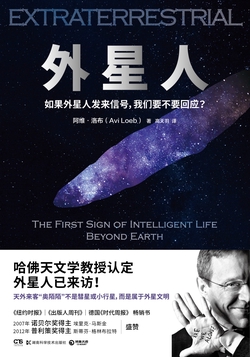
The value of this book far exceeds ordinary UFO curiosity reads. First, it is a brilliant exemplar of how to apply the scientific method to 'anomalous phenomena.' Loeb details the entire process from formulating hypotheses and seeking evidence to responding to academic skepticism, revealing the real ecology and intellectual courage of frontier scientific exploration. Second, it profoundly explores the tension between scientific conservatism and innovative thinking, offering blunt criticism of the scientific community's ingrained 'Earth-centrism.' For readers, this is not only a discussion of the possibility of extraterrestrial life but also a philosophical reflection on the boundaries of human cognition, scientific paradigm shifts, and our place in the universe. Loeb's clear, eloquent prose makes complex astrophysical concepts accessible, ensuring a balance between professionalism and readability.
Who it's for
A good fit for
- Science enthusiasts with a strong interest in astrophysics and SETI (the search for extraterrestrial intelligence)
- Readers who enjoy science controversies and the sociology of science
- Thinkers seeking breakthroughs in thinking and open to challenging mainstream views
- Science fiction readers and futurists concerned with humanity's future and cosmic civilization
Not a good fit for
- Readers expecting traditional alien contact stories or science fiction
- Readers who firmly believe all unknown phenomena must have known natural explanations and reject non-mainstream scientific hypotheses
Reading tips
- Read alongside original papers on 'Oumuamua' and subsequent academic debate coverage for a more well-rounded understanding
- Compare with works such as Carl Sagan's Pale Blue Dot to reflect on humanity's humility and curiosity in the universe
- Pay attention to the scientific methodology Loeb repeatedly emphasizes: bold hypotheses based on evidence and rigorous verification, rather than blind belief or outright dismissal
About the publisher
Hunan Science & Technology Press has long focused on science popularization and medical publishing, balancing academic depth with accessibility for general readers. Among the 462 titles in the database are Richard Feynman's classic lectures on QED, the nature of physical laws, and relativity in the "Approaching Feynman" series, as well as general-audience works such as George Gamow's One, Two, Three... Infinity and Sean Carroll's The Big Picture. Its paleontology and dinosaur list includes Gregory S. Paul's Princeton field guides and authors such as Xing Lida. Hermann Weyl's Symmetry further reflects the press's attention to classic works bridging science and the humanities. Overall, the publisher shows a clear author profile and an emphasis on illustrated, well-rounded science publishing across both translated and original titles.
Contents
- 版权信息
- 前言
- 第一章 宇宙侦察兵
- 第二章 家乡的农场
- 第三章 异常现象
- 第四章 星之芯片
- 第五章 光帆假说
- 第六章 贝壳与浮标
- 第七章 向孩子学习
- 第八章 广袤无垠
- 第九章 过滤器
- 第十章 天文考古学
- 第十一章 奥陌陌的赌局
- 第十二章 播种
- 第十三章 奇点
- 尾声
- 后记
- 致谢
- 注释
- 扩展阅读
FAQ
Is the book's viewpoint widely accepted by the scientific community?
Do I need a strong astronomy background to understand it?
Is this book only about 'Oumuamua'?
Related on WeRead


Comments
Find this book
This site is an index: you start “Search all sources” in your browser, and the entries it lists all point to third-party sites; please judge their availability yourself.
About the author
Avi Loeb is the author of the popular science book Extraterrestrial. At present, the Chinese book database includes only this one work by him, commonly classified as popular science. Public information about his nationality, dates of birth and death, educational background, and professional career is limited, and the database provides no further personal details, so speculation beyond this is inappropriate. Judging from Extraterrestrial, his representative work, his writing focuses on cutting-edge scientific topics such as extraterrestrial life and the exploration of the universe, introducing related scientific questions and research approaches to general readers. Popular science writing of this kind generally needs to balance scientific rigor with readability, translating complex astronomical, biological, and physical concepts into language accessible to the public and prompting readers to reflect on humanity's place in the cosmos. On the basis of the available information, he can be described as a popular science author whose work takes the universe and the question of life as its entry point, offering Chinese-language readers a way into these discussions.
Gao Tianyu is a Chinese translator and author whose work spans several fields. Public information about him is limited, and little is recorded about his life. Judging from the seventeen titles in the library, his translations and writings range across narrative nonfiction, popular science, medicine, science fiction, and world history. His representative translations include the cardiac surgeon's memoir Open Heart, the investigative report The Truth About Generic Drugs, The Thief Who Stole the Mind on Alzheimer's disease, and Neuro Logic, which explores human behavior and the workings of the brain; he has also translated A Knife's Edge Life, Catastrophe, and The Distant Earth Song. In his choice of material he favors works that combine professional depth with readable storytelling, and he is skilled at rendering specialized subjects such as medicine, neuroscience, and public health into fluent Chinese, helping readers understand science through narrative. His translations have thus gained a following among readers of popular science and narrative nonfiction.
