

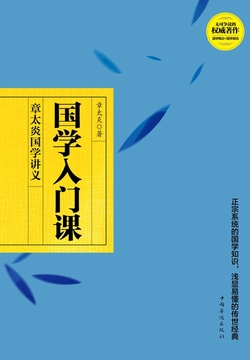
An Introductory Course in Chinese National Studies
Tags
Summary
Editor's review
Reading this book, readers can deeply feel the breadth and depth of Zhang Taiyan's scholarship. When he discusses the Shuowen Jiezi, he not only explains glyphs and meanings but also connects them to ancient social institutions and cultural psychology; when he discusses the various masters, he compares them vertically and horizontally, revealing the evolution of thought. This way of explaining specific knowledge by placing it within a grand historical and cultural context is the most essential part of the book. However, readers should also note that Zhang's remarks are sometimes vehement, and some of his specific academic views (such as his views on oracle bone script) have been surpassed by later research. Therefore, this book is better suited as a window into the academic landscape of the Republic of China era and a glimpse of the master's way of thinking, rather than a textbook for obtaining definitive knowledge. For readers intent on delving deeply into national studies, following the master's pointed path and cultivating an emphasis on primary sources and critical thinking is far more important than memorizing the specific conclusions in the book.
Who it's for
A good fit for
- Chinese department students or enthusiasts with some classical Chinese foundation who wish to systematically understand the scope and methods of national studies
- Researchers interested in the academic and intellectual history of the late Qing and early Republic, who want to view the academic style of that era through representative figures
- Advanced readers who have already read some introductory works on national studies and wish to further encounter the master's original, highly personal insights
- Readers seeking a path to traditional learning different from currently popular interpretations, eager to encounter a critical and evidential approach
Not a good fit for
- Absolute beginners expecting a relaxed, story-based introduction to national studies
- Readers seeking standard answers or systematic textbooks, who find it hard to accept personalized, controversial views in academic history
Reading tips
- It is recommended to first read through the preface and first chapter to grasp Zhang Taiyan's definition of the scope of national studies and the core of his methodology, then choose chapters of interest for deeper reading
- While reading, keep the Shuowen Jiezi or related reference works at hand, verifying as you go, to practice Zhang's scholarly approach of emphasizing "xiaoxue"
- Read alongside materials on modern academic history to understand the significance and limitations of Zhang Taiyan's views in their historical context, forming a three-dimensional understanding
About the publisher
China Overseas Publishing House focuses on philosophy, history, world classics and mystery and detective fiction, with a secondary interest in foreign literature and folk literature. Its catalogue of roughly 960 titles includes Wittgenstein's Tractatus Logico-Philosophicus, Jiang Tingfu's Modern Chinese History, Margaret Mitchell's Gone with the Wind, Arthur Conan Doyle's Complete Sherlock Holmes, Antoine de Saint-Exupéry's The Little Prince, as well as Classic Collected Edition of Greek Myths and a beautifully illustrated edition of Zhuangzi, giving it a publishing profile centred on classic translations and traditional Chinese culture. Its authors and translators range from Wittgenstein, Jiang Tingfu, Mitchell, Conan Doyle and Saint-Exupéry to Huang Min, Fu Donghua and Liu Shijie. Public information about its editorial philosophy and series system is limited.
Contents
- 版权信息
- 编者序
- 代序:国学之统宗
- 上卷 国学概论
- 第一章 概论
- 第二章 经学之派别
- 第三章 哲学之派别
- 第四章 文学之派别
- 第五章 结论:国学如何进步
- 下卷 国学略说
- 第一章 小学讲义
- 第二章 经学解说
- 第三章 史学研究
- 第四章 文学略讲
- 第五章 诸子百家
FAQ
What are the fundamental differences between this book and other "Introduction to National Studies" books on the market?
Can I understand this book without a solid foundation in classical Chinese?
Are all of Zhang Taiyan's views in the book correct? How should we regard them?
Related on WeRead
 国学入门课
 经典常谈(插图本)(《语文》八年级下推荐阅读。朱自清讲给青年学子的13堂国学常识课,了解中国古代文化典籍的入门读本)
 美国大历史 美国国学基础入门书百科传统文化 美国历史战争文化文物文学哲学艺术畅销书学生语文课外阅读拓展
Comments
Find this book
This site is an index: you start “Search all sources” in your browser, and the entries it lists all point to third-party sites; please judge their availability yourself.
About the author
Zhang Binglin (Zhang Taiyan, 1869–1936), style name Taiyan, was a native of Yuhang, Zhejiang. A democratic revolutionary, thinker, and master of Chinese classical learning in the late Qing and early Republican era, he edited the Min Bao, the official newspaper of the Tongmenghui, and was known both for his revolutionary stance and his deep scholarly attainments. His research spanned the classics, history, philology, and the various schools of thought. His works include Qiu Shu, Guogu Lunheng, Wenshi, and Xin Fangyan, written in an archaic, rigorous style that combines polemical force with solid textual scholarship. He lectured and wrote for many years, and his students included Huang Kan, Qian Xuantong, and Lu Xun, giving him a profound influence on modern scholarship and literature. This library holds 24 of his works, covering classics, Eastern philosophy, literary appreciation, and culture, including public-domain editions of Guogu Lunheng and Qiu Shu as well as lectures on national learning and academic history, offering readers different angles on his thought and prose style.
