

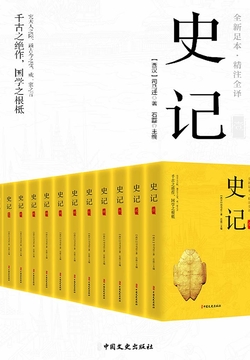
Records of the Grand Historian (Volume X)
Tags
Summary
The Shiji comprises 130 chapters in total, including twelve Annals (benji, records of the achievements of successive rulers), thirty Hereditary Houses (shijia, records of the rise and fall of the feudal states and of Han nobles and meritorious officials), seventy Biographies (liezhuan, records of the words and deeds of important figures, mainly ministers, the last of which is the author's own preface), ten Tables (chronological tables of major events), and eight Treatises (shu, on ritual, music, pitch pipes, the calendar, astronomy, the Feng and Shan sacrifices, water conservancy, and finance). All-embracing yet coherent and clearly organized, it faithfully records the political, economic, military, and cultural development of remote antiquity.
The Shiji is also an outstanding literary work and holds an important place in the history of Chinese literature. In terms of historiographical value, it preserves several thousand years of historical sources and is of extraordinary significance, being ranked first among the Twenty-Four Histories. It pioneered the biographical method of recording events and has been held in high esteem by historians and scholars through the ages. In terms of literary value, its descriptive language is vivid, its characters sharply drawn, its reasoning penetrating, and its narrative flexible. Liu Xiang and others praised the book as "skilled in setting forth events and principles, lucid without ostentation, plain without vulgarity."
Editor's review
Who it's for
A good fit for
- Readers who have systematically read the first nine volumes of the Records and wish to fully appreciate the work's overall thread and spirit
- Researchers with a strong interest in Sima Qian's life, historiographical thought, and the making of the Records
- Deep readers who hope to draw strength of character from classics and explore spiritual perseverance in adversity
- University teachers and students focusing on Qin–Han history, ancient historiographical theory, or biographical literature
Not a good fit for
- Beginning readers seeking only light storytelling or a general overview of history
- Readers who have not yet encountered the main content of the Records and would find Volume 10 disconnected from its context if read directly
Reading tips
- It is recommended to read "The Autobiographical Postface of the Grand Historian" alongside "Letter in Reply to Ren An" to gain a more comprehensive grasp of Sima Qian's views on life and death and his ideals of authorship.
- Keep notes while reading to sort out the chapter structure of the whole work and techniques such as the "mutual-see method" revealed in the "Postface"; this helps in reviewing the content of the first nine volumes.
- For chapters such as "Turtle and Milfoil Divination" and "Day Diviners," understand them in light of Han-era social thought and cultural background, avoiding simple judgment by modern standards.
About the publisher
China Culture and History Press has long devoted itself to modern and contemporary literature and culture-and-history reading matter, with publishing directions centered on classic works, social novels, prose and miscellaneous writings, and Eastern philosophy, alongside culture-and-history periodicals such as Zongheng. Among the more than 1,500 titles in the collection, representative books include Zhang Henshui's Ti Xiao Yin Yuan, Lu Xun's Complete Classic Works (10 volumes) and Wild Grass, and Lao She's Four Generations Under One Roof series and the boxed set of Lao She's Classic Works (10 volumes), while its author resources are concentrated on figures such as Zhang Henshui, Lu Xun, Lao She and Sima Qian. Its publishing character lies in solid editorial work on culture-and-history source texts and in issuing famous authors' works in sets, balancing the readability of individual texts with the systematic presentation of complete collections for focused reading and collecting. Beyond these directions, public information on the press's contemporary original publishing is limited, so it is not elaborated here.
Contents
- 版权信息
- 第九十九卷 司马相如列传第五十七
- 第一百卷 淮南衡山列传第五十八
- 第一百零一卷 循吏列传第五十九
- 第一百零二卷 汲郑列传第六十
- 第一百零三卷 儒林列传第六十一
- 第一百零四卷 酷吏列传第六十二
- 第一百零五卷 大宛列传第六十三
- 第一百零六卷 游侠列传第六十四
- 第一百零七卷 佞幸列传第六十五
- 第一百零八卷 滑稽列传第六十六
- 第一百零九卷 日者列传第六十七
FAQ
Does this volume contain the entire content of the Records?
Can I start reading directly from Volume 10?
What are the features of this edition?
Related on WeRead



Comments
Find this book
This site is an index: you start “Search all sources” in your browser, and the entries it lists all point to third-party sites; please judge their availability yourself.
About the author
Sima Qian was a historian, man of letters, and thinker of the Western Han dynasty. His courtesy name was Zichang, and he was a native of Xiayang in Zuo Fengyi (present-day Hancheng, Shaanxi). Succeeding his father Sima Tan as Grand Astrologer, he traveled widely to collect historical materials. Later, having suffered punishment in connection with the Li Ling affair, he endured humiliation and devoted himself to his work, ultimately completing the Records of the Grand Historian (Shiji, originally titled Taishigong shu), China's first comprehensive history in the biographical (jizhuanti) style. The work covers events from the Yellow Emperor down to Emperor Wu of Han, organizing three thousand years of history through the five sections of annals, tables, treatises, hereditary houses, and biographies. Its narrative is concise and richly literary, its characters vividly drawn, and it has been praised as "the supreme swan song of historians." Later generations have often classified his writings under historical reading and Eastern philosophy, and his influence on Chinese historiography and literature has been profound.
Shi Lei, born in 1962, graduated from Harbin Normal University and is a freelance writer and scholar. He has long worked in writing, editing, reporting and planning, and has opened columns in several media outlets, publishing more than one million words. His writing focuses on public speaking, communication training and mental health, and he has served as chief editor of several book series on the art of speaking, inspirational life guidance, the thought of world masters, and mental health, bringing practical knowledge of expression, interpersonal communication and psychological adjustment to general readers. Twenty-seven of his works are included in the library, including several volumes related to the Records of the Grand Historian, with Eastern philosophy as a common category. Public information is limited and few details of his life are recorded, but his existing works show an emphasis on practicality and readability, and a tendency to connect traditional culture with topics of everyday self-cultivation.
