

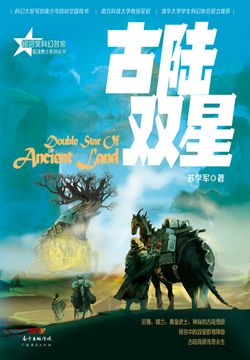
Twin Stars of the Ancient Land
Tags
Summary
Editor's review
In terms of reading value, the book successfully weaves together Western Regions history, archaeological discoveries, and the alien civilization hypothesis, creating a narrative space where a familiar yet alien near-future and deep past intertwine. The desert settings are vividly rendered, the scientific research is rigorous, and the technical details are rich—satisfying the expectations of hard SF fans. Meanwhile, the dual narrative structure—a modern expedition line and a line tracing the decline of an ancient civilization—advances in parallel, building suspense layer by layer until the two converge in a striking truth, delivering a powerful sense of immersion and intellectual impact.
In the editor's view, the value of this work lies not only in its engaging story but also in the new perspective it offers on our own civilization. Beneath the science fiction exterior is a profound reflection on humanity's fate and choices. The book's discussions of resources, the environment, and civilizational survival feel especially relevant today.
Who it's for
A good fit for
- Readers with a strong interest in hard science fiction and archaeological adventure
- Fans of science fiction that combines scientific speculation with humanistic reflection
- Readers interested in Chinese domestic science fiction, especially stories that incorporate historical and cultural elements
- Readers seeking an entertaining read that also prompts deeper reflection on civilization and ecology
Not a good fit for
- Science fiction readers looking for pure space opera or fast-paced action
- Readers with little patience for detailed scientific or archaeological description
Reading tips
- Pay attention to how the two narrative threads echo each other, and how the author weaves past and present into a complete narrative loop.
- Note the author's descriptions of the Taklamakan's geography and climate—they not only set the atmosphere but are themselves key drivers of the plot.
- Take your time with the scientific and archaeological worldbuilding; it forms the foundation of the story's credibility.
About the publisher
Founded in 1995, Guangdong Economic Publishing House publishes in fields including economic management, investment and personal finance, finance and securities, applied psychology, popular science, and documentary literature. Its catalog ranges from investment classics such as Philip A. Fisher's "Paths to Wealth Through Common Stocks" to Michael J. Mauboussin's "More Than You Know," which blends finance, psychology, and management. In psychology and documentary writing, it offers works such as Stephanie Foo's "What My Bones Know," Lu Xiaoya's "Being a Mother to My Mother," and "When My Mother Got Alzheimer's." The list combines translations and original works, with authors from China and abroad in finance and psychology. Given limited public information, this profile reflects only the titles held in our catalog.
Contents
- 版权信息
- 上卷·尼雅
- 一、小河之战
- 二、尼雅的曙光
- 三、危机重重
- 四、意乱情迷
- 五、烽烟四起
- 六、血色白塔
- 七、海市幻影
- 下卷·绿湖
- 一、绿湖印象
- 二、靠近的心
- 三、命运之结
- 四、末日临近
- 五、无名英雄
- 六、终战
- 七、不灭的双星
- 尾声
FAQ
Is this a pure science fiction novel?
How is the pacing?
What characterizes Su Xuejun's writing style?
Related on WeRead
Comments
Find this book
This site is an index: you start “Search all sources” in your browser, and the entries it lists all point to third-party sites; please judge their availability yourself.
About the author
Su Xuejun is an author in the field of Chinese science fiction. Publicly available information about him is limited, and details such as his nationality, dates of birth and death, and educational background remain unclear. The library currently holds six of his works, including Ancient Stars, the five-volume Star Soul Warriors series, Heroes of the Ancient Land, Glory of the Star Sea, Memory Wanderer, and Twin Stars of the Ancient Land. These works are mostly classified as science fiction and classic works, with themes spanning ancient civilizations, interstellar exploration, virtual memory, and heroic growth, suggesting a tendency to blend science fiction concepts with reading suitable for young audiences. Among them, the Galaxy Award Science Fiction Masters Youth Series: Star Soul Warriors, presented as a series for young readers, reflects an extension of his writing toward popularizing science fiction. Overall, Su Xuejun's writing combines grand imagination with readability and holds a certain significance in the dissemination of Chinese science fiction among young readers.
