

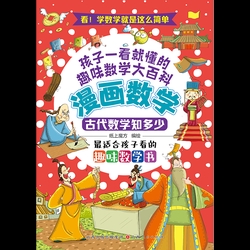
How Much Do You Know About Ancient Mathematics
Tags
Summary
How heavy is a “five-dou” measure of rice?
How many soldiers and horses did a “state of a thousand chariots” have?
How many men were the “300 warriors” really?
How did people count years in ancient times?
What mathematics lies in the Heavenly Stems and Earthly Branches?
……
Let us step into history and seek out mathematical treasures!
Editor's review
From an editorial perspective, the book's greatest value lies in its role as a "bridge"—it successfully establishes a connection between history and the humanities on one hand and mathematical thinking on the other. Its accessible interpretations of classics such as The Nine Chapters on the Mathematical Art and Elements open a door for young readers to understand ancient scientific thought. The organization uses a thematic structure, with each chapter focusing on a civilization or a mathematical field; the density of knowledge is moderate and suited to how young people learn.
It should be noted that the book has a clear positioning as an introductory popular-science work. It does not pursue depth or systematic coverage of mathematical knowledge, but focuses on sparking interest and cultivating an appreciation of mathematical culture. The illustration style is lively, though some diagrams are highly simplified, and professional readers may find the depth insufficient. Overall, this is an excellent mathematical primer, especially suitable as supplementary material for school mathematics education, allowing children to experience the charm and warmth of mathematics through historical stories.
Who it's for
A good fit for
- Primary and middle school students interested in the history of mathematics
- Parents hoping to cultivate their children's interest in mathematics
- Teachers looking for interdisciplinary teaching materials
- Readers who enjoy illustrated popular-science books
Not a good fit for
- Professional readers seeking in-depth theoretical research in mathematics
- Exam candidates expecting a systematic body of mathematical knowledge
Reading tips
- Read in order of civilizations to follow the historical trajectory of mathematical development
- Work through the fun problems in the book by hand to deepen understanding
- Read alongside other popular books on the history of mathematics to broaden perspective
About the publisher
Founded in 1951, Shanxi People's Publishing House is a comprehensive publisher known for its books on history, culture and fine arts, with a list covering politics, economics, history, culture, ancient texts, art, and textbooks and teaching materials. Judging from the 108 titles in the database, history and biography form an important part of its output: Huang Yongnian's A History of Chinese Politics from the Sixth to the Ninth Century, Zhu Dongrun's Biography of Zhang Juzheng and Agricultural Geography of the Song Dynasty reflect a solid grounding in historical scholarship and ancient texts. In biography and social science it has published works such as Pursuit: Comfort Woman Park Young-hee and Her Sisters. In the areas of inspirational growth and foreign literature, Chinese translations of Dale Carnegie's How to Win Friends and Influence People and How to Stop Worrying and Start Living, and Hemingway's The Old Man and the Sea, enrich its popular reading list. Its authors include Huang Yongnian, Zhu Dongrun, Dale Carnegie, Hemingway and Su Zhiliang, giving the house an overall profile centred on history, culture and the humanities and social sciences, while also embracing popular inspirational and classic literary titles.
Contents
- 版权信息
- 第一章 古代度量衡
- 退多远的距离才是“退避三舍”?
- 古代的一尺是多长?
- 古代钱币怎么计算?
- “半斤八两”是怎么计算的?
- “五斗米”有多重?
- “千乘之国”的兵马有多少?
- 度量衡的统一
- “无规矩不成方圆”中的数学原理
- 第二章 古代虚报数额
- “九鼎”的历史意义
- “300勇士”到底有多少人?
- 真能活到“九千九百岁”吗?
- 号称“八十三万”的大军
- 名字里的数字含义
- 《四库全书》编著中的惊人数字
- 第三章 奇特的历史称谓
- 什么是“二桃杀三士”?
- 哪“三家”瓜分了晋?
- “战国七雄”有哪些?
- 什么是“八股文”?
- 哪些人属于“三公”与“九卿”?
- 什么是“五代十国”?
- 古代官级的划分
- 什么是“五胡十六国”?
- “九族”有哪些亲戚?
- 第四章 古代数学应用
- 什么是“连中三元”?
- “六艺”包含哪些知识?
- 《道德经》里的“一、二、三”
- 古代数学家
- 古代“十圣”是什么?
- 古代怎么纪年的?
- 天干地支的数学知识
- 八卦阵与数学
FAQ
What age group is this book suitable for?
Does the book include math exercises?
Does the content cover the history of Chinese mathematics?
Related on WeRead
Comments
Find this book
This site is an index: you start “Search all sources” in your browser, and the entries it lists all point to third-party sites; please judge their availability yourself.
About the author
Zhishang Mofang is the creative byline used by Beijing Zhishang Mofang Culture Communication Co., Ltd., a professional book studio founded in 2010 that integrates book planning, editing, and design. The studio focuses mainly on popular science for children and has expanded into several other categories. The library holds 19 of its titles, commonly classified under social sciences and popular science. Representative works include Everything Has Mathematics, How Much Do You Know About Mathematical Anecdotes, Chatting About Numbers, How Much Do You Know About Ancient Mathematics, and Wonderful Figures, as well as The King of the Graphic World: Understanding Plane Figures from the series Mathematics Hidden in Stories. These works center on mathematical knowledge and combine abstract concepts with figures, stories, and everyday scenarios in an accessible style suited to young readers. Public information is limited, and further details about the studio's staff and creative process are not available.
