

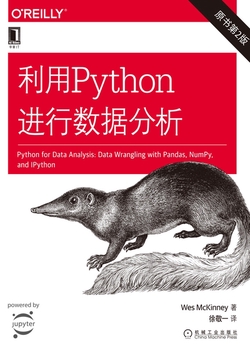
Python for Data Analysis (Original Book, 2nd Edition)
Tags
Summary
Editor's review
From a professional standpoint, the book's value goes beyond that of a technical manual. As the creator of the tools, McKinney reveals the design logic and best practices of libraries such as pandas—a depth few other tutorials can match. The explanations of core concepts such as data wrangling, aggregation, and time series are especially incisive; combined with real dataset cases, they help readers not only master the tools but also build a framework for thinking about data analysis.
Of particular note are Chapter 10 on data aggregation and group operations and Chapter 13 on Python modeling libraries, which raise Python data analysis to the level of industrial-grade applications. For practitioners who need to handle large-scale, complexly structured data, the techniques and methodology in this book offer direct productivity value.
Note that the book assumes prior Python knowledge and is better suited as an intermediate-level advanced text than an introductory one. Its real strength lies in helping developers with some experience systematize their knowledge and bridge the gap between "knowing how to use the tools" and "mastering data analysis."
Who it's for
A good fit for
- Developers with Python basics who need to learn data analysis systematically
- Practitioners in data science, business analysis, and similar fields who need to strengthen hands-on skills
- Technical professionals who want a deep understanding of the design philosophy and best practices of libraries such as pandas
- Researchers or analysts who need to process large-scale structured data
Not a good fit for
- Absolute beginners with no programming background
- Users who only need simple data visualization and are not involved in the core data processing workflow
Reading tips
- Master basic Python syntax and NumPy operations before reading this book
- When practicing, use Jupyter Notebook to follow the book's cases step by step
- Focus on Chapters 4–8, the core data processing chapters, which cover the skills used most frequently in daily work
About the publisher
In addition to science and technology and professional publishing, the books in our catalog from China Machine Press also reflect a sustained focus on psychology, computing, management, finance and economics, and social sciences. In psychology, the catalog includes works by C. G. Jung and introductions to analytical psychology, as well as applied topics such as stress and health, and addiction and healing. In computing, it features Structure and Interpretation of Computer Programs (JavaScript Edition). Management and finance titles include Administrative Behavior (4th Edition), The Price of Inequality (Collector's Edition), and This Time Is Different: Eight Centuries of Financial Folly (Commemorative Edition). In the philosophy and history of science, there is The Worldview: The Third Edition. Relevant authors include C. G. Jung, William McGuire, Sonu Shamdasani, and Gabor Maté. Public information is limited; the above summarizes the publisher's profile based solely on the books in our catalog.
Contents
- 版权信息
- 作者介绍
- 封面介绍
- 译者序
- 前言
- 第1章 准备工作
- 1.1 本书内容
- 1.2 为何利用Python进行数据分析
- 1.3 重要的Python库
- 1.4 安装与设置
- 1.5 社区和会议
- 1.6 快速浏览本书
- 第2章 Python语言基础、IPython及Jupyter notebook
- 2.1 Python解释器
- 2.2 IPython基础
- 2.3 Python语言基础
- 第3章 内建数据结构、函数及文件
- 3.1 数据结构和序列
- 3.2 函数
- 3.3 文件与操作系统
- 3.4 本章小结
- 第4章 NumPy基础:数组与向量化计算
- 4.1 NumPy ndarray:多维数组对象
- 4.2 通用函数:快速的逐元素数组函数
- 4.3 使用数组进行面向数组编程
- 4.4 使用数组进行文件输入和输出
- 4.5 线性代数
- 4.6 伪随机数生成
- 4.7 示例:随机漫步
- 4.8 本章小结
- 第5章 pandas入门
- 5.1 pandas数据结构介绍
- 5.2 基本功能
- 5.3 描述性统计的概述与计算
- 5.4 本章小结
- 第6章 数据载入、存储及文件格式
- 6.1 文本格式数据的读写
- 6.2 二进制格式
- 6.3 与Web API交互
- 6.4 与数据库交互
- 6.5 本章小结
- 第7章 数据清洗与准备
- 7.1 处理缺失值
- 7.2 数据转换
- 7.3 字符串操作
- 7.4 本章小结
- 第8章 数据规整:连接、联合与重塑
- 8.1 分层索引
- 8.2 联合与合并数据集
- 8.3 重塑和透视
- 8.4 本章小结
- 第9章 绘图与可视化
- 9.1 简明matplotlib API入门
- 9.2 使用pandas和seaborn绘图
- 9.3 其他Python可视化工具
- 9.4 本章小结
- 第10章 数据聚合与分组操作
- 10.1 GroupBy机制
- 10.2 数据聚合
- 10.3 应用:通用拆分-应用-联合
- 10.4 数据透视表与交叉表
- 10.5 本章小结
- 第11章 时间序列
- 11.1 日期和时间数据的类型及工具
- 11.2 时间序列基础
- 11.3 日期范围、频率和移位
- 11.4 时区处理
- 11.5 时间区间和区间算术
- 11.6 重新采样与频率转换
- 11.7 移动窗口函数
- 11.8 本章小结
- 第12章 高阶pandas
- 12.1 分类数据
- 12.2 高阶GroupBy应用
- 12.3 方法链技术
- 12.4 本章小结
- 第13章 Python建模库介绍
- 13.1 pandas与建模代码的结合
- 13.2 使用Patsy创建模型描述
- 13.3 statsmodels介绍
- 13.4 scikit-learn介绍
- 13.5 继续你的教育
- 第14章 数据分析示例
- 14.1 从Bitly获取1.USA.gov数据
- 14.2 MovieLens 1M数据集
- 14.3 美国1880~2010年的婴儿名字
- 14.4 美国农业部食品数据库
- 14.5 2012年联邦选举委员会数据库
- 14.6 本章小结
- 附录A高阶NumPy
- 附录B更多IPython系统相关内容
FAQ
How much Python background does this book require?
What has been updated in the second edition compared with the first?
How does this book differ from Python Data Science Handbook?
Related on WeRead
Comments
Find this book
This site is an index: you start “Search all sources” in your browser, and the entries it lists all point to third-party sites; please judge their availability yourself.
About the author
Wes McKinney is a technical author known for his work on data analysis and scientific computing, and his Chinese name is often associated with the topic of Python data analysis among readers of computer books. Publicly available information is limited: his nationality, birth and death dates, and educational background are not conclusively recorded, and the library currently holds one of his works. His representative work is Python for Data Analysis (2nd Edition), which focuses on the practical use of Python in data processing, cleaning, wrangling, and analysis. The book emphasizes tool operation and case demonstrations and is a practical technical work in the general computer category. McKinney's writing style combines programming methods with real data scenarios; the language is direct and the steps are clear, making it suitable for readers who want to use Python for data analysis. The book has circulated widely among Chinese readers, is often regarded as one of the introductory works for entering the field of Python data analysis, and reflects the author's practical experience and approach to data handling.
Xu Jingyi is an author about whom limited public information is available. The main work visible in the library is the Chinese translation of Python for Data Analysis (2nd Edition), a book in the general computer science category. The book explains how to use Python, a programming language, for data cleaning, processing, and analysis, and is aimed at readers who want to learn practical data analysis tools and methods. As the translator, Xu Jingyi's task is to render the original technical explanations and examples accurately into Chinese, enabling Chinese readers to follow the concepts and procedures smoothly. Based on the available information, the translation serves the practical purpose of a technical textbook, with clear expression and consistent terminology that make it easy for readers to study alongside the original. Since the author's biography, professional background, and other writings are not clearly documented, no speculation is made here; the description is limited to the field and purpose of this translated work.
