

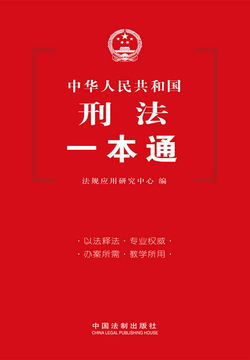
Criminal Law in One Book
Tags
Summary
Editor's review
Who it's for
A good fit for
- Criminal justice practitioners, such as lawyers, prosecutors, and judges
- Students and researchers in law at universities
- Corporate legal and compliance personnel who need a systematic understanding of criminal law norms
- Law enthusiasts with a strong interest in criminal law who wish to study it systematically
Not a good fit for
- General leisure readers seeking storytelling-style, popularized interpretations of criminal law
- Beginners who only need the most basic common knowledge of criminal law and no in-depth detail
Reading tips
- Use it as a reference book: consult it by specific question or article index rather than reading it cover to cover.
- While reading, focus on the related documents under each article and understand how judicial interpretations and the like apply legal principles in practice.
- Study alongside specific cases: use the book to locate relevant norms and deepen your understanding of the connection between theory and practice.
About the publisher
China Legal Publishing House is a legal publisher overseen and sponsored by the Ministry of Justice, with the publication of standard texts of national laws and regulations as an important focus; its catalogue already contains 2,972 titles. Its publications cover fields such as criminal law, civil law, contract law, company law, real estate law and the security system, including article-by-article commentaries such as the Interpretation of the Contract Part of the Civil Code of the People's Republic of China, adjudication rules and case compilations oriented toward judicial practice such as Understanding and Applying Adjudication Rules in Contract Disputes and A Compendium of Court Views on Real Estate Cases, as well as legal classics such as On Crimes and Punishments and academic works such as The Theory of Procedural Sanctions. In terms of author resources, the publisher brings together classic legal authors such as Cesare Beccaria, scholars and practitioners such as Liu Junhai, Long Weiqiu and Zhu Shuying, and cooperates with institutions including the National Judges College and the Judicial Case Research Institute of the Supreme People's Court. Its publishing character lies in linking legal texts, scholarly interpretation and judicial application, balancing authoritative norms with practical guidance.
Contents
- 版权信息
- 编辑说明
- 第一编 总 则
- 第一章 刑法的任务、基本原则和适用范围
- 第二章 犯 罪
- 第三章 刑 罚
- 第四章 刑罚的具体运用
- 第五章 其他规定
- 第二编 分 则
- 第一章 危害国家安全罪
- 第二章 危害公共安全罪
- 第三章 破坏社会主义市场经济秩序罪
- 第四章 侵犯公民人身权利、民主权利罪
- 第五章 侵犯财产罪
- 第六章 妨害社会管理秩序罪
- 第七章 危害国防利益罪
- 第八章 贪污贿赂罪
- 第九章 渎 职 罪
- 第十章 军人违反职责罪
- 附则
- 附录
FAQ
How is this book different from a standalone copy of the Criminal Law?
Is the book's content updated promptly?
Can someone without a law degree understand this book?
Related on WeRead
Comments
Find this book
This site is an index: you start “Search all sources” in your browser, and the entries it lists all point to third-party sites; please judge their availability yourself.
About the author
The Legal Application Research Center is a research institution affiliated with China Legal Publishing House (China Rule of Law Publishing House). It is composed of senior editors engaged in planning and publishing books on laws and regulations and cases, as well as law professors from universities, and specializes in the editing and research of legal reference books. The Center has planned and published practical legal works such as the "Laws in One Book" series. Its output in the collection numbers 114 titles, including the Practical Handbook for Court Enforcement (8th Edition), the Supreme People's Court and Supreme People's Procuratorate Judicial Interpretations and Guiding Cases: Civil Volume (5th Edition), Criminal Law in One Book, and Civil Procedure Law in One Book. Its common categories are law and social sciences. Its compilations emphasize cross-referencing of legal provisions with cases and judicial interpretations, serving legal practitioners and learners with convenient consultation and practical content. Public information is limited, and its specific members and founding date have not been disclosed.
