

Ethics
Tags
Summary
Editor's review
Who it's for
A good fit for
- Deep readers with a strong interest in the history of Western philosophy, especially the rationalist tradition
- Thinkers seeking to go beyond shallow self-help and understand the nature of happiness and freedom from philosophical foundations
- Readers unafraid of abstract speculation and rigorous logical argumentation who enjoy intellectual challenges
- Scholars and advanced students researching ethics, metaphysics, or Spinoza's thought
Not a good fit for
- Practical readers expecting a book offering specific moral conduct guidelines or life advice
- Readers with no philosophical background who wish for easy introduction or fragmented reading
Reading tips
- On first reading, one may temporarily skip the elaborate geometric proofs and first grasp the core definitions, propositions, and corollaries of each part, understanding the argumentative thread and core conclusions
- It is recommended to read alongside chapters on Spinoza in histories of Western philosophy to understand the historical background of his thought and its transitional position
- Be patient while reading; prepare notes to sort out the definitions and connections of core concepts (such as substance, attribute, mode, causa sui), which is key to understanding the whole book
About the publisher
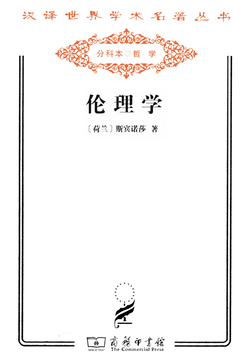
The Commercial Press is a publisher known for classic works and academic publishing, with titles spanning Eastern philosophy, foreign literature, world history, social culture, and applied psychology. Its list includes classical commentaries such as Zhu Xi's Collected Commentaries on the Analects and Wang Bi's Commentary on the Zhouyi, as well as modern annotated translations like Zhuangzi with Modern Notes and Translation. In foreign literature it offers War and Peace and Crime and Punishment, while in world history it carries Braudel's The Mediterranean and the Mediterranean World in the Age of Philip II. Applied psychology is represented by Irvin D. Yalom's Existential Psychotherapy, and ethical texts include a Greek-Chinese-English edition of the Nicomachean Ethics. Its authors and translators include Zhu Xi, Wang Bi, Yalom, Braudel, and translators such as Huang Zheng, Zhang Yiling, Shen Dongyu, and Tang Jialong, balancing the editing of original texts with academic translation.
Contents
- 版权信息
- 汉译世界学术名著丛书
- 出版说明
- 第一部分 论神
- 界说
- 公则
- 附录
- 第二部分 论心灵的性质和起源
- 界说
- 公则
- 公设
- 第三部分 论情感的起源和性质
- 序言
- 界说
- 公设
- 情绪的界说
- 第四部分 论人的奴役或情感的力量
- 序言
- 界说
- 公则
- 附录
- 第五部分 论理智的力量或人的自由
- 序言
- 公则
- 译后记
FAQ
Why is this book called Ethics when its content resembles geometry and metaphysics?
Can one understand this book without a philosophical background?
What are the features of this Commercial Press edition?
Related on WeRead


Comments
Find this book
This site is an index: you start “Search all sources” in your browser, and the entries it lists all point to third-party sites; please judge their availability yourself.
About the author
Baruch de Spinoza (1632–1677) was a seventeenth-century Dutch rationalist philosopher and a forerunner of the Enlightenment, born into a Portuguese-Jewish family in Amsterdam. Expelled from the Jewish community in 1656, he thereafter earned his living grinding optical lenses. He advanced a monism of substance and a pantheistic view that identified God with nature, set out chiefly in works such as Ethics and the Theologico-Political Treatise. His writings also address the improvement of the understanding, God, man and his well-being, and the principles of Descartes' philosophy, along with his correspondence, spanning metaphysics, epistemology, politics, and religious criticism. His work is known for its geometric method of argument, precise concepts, and restrained expression, and has had a profound influence on later philosophy.
He Lin (1902–1992) was a native of Jintang, Sichuan, and a renowned modern Chinese philosopher, translator, and educator, as well as a representative of modern New Confucianism. He studied in the United States and Germany and taught for many years at Peking University; in 1955 he joined the Institute of Philosophy of the Chinese Academy of Sciences. He devoted his life to translating and studying Western philosophy, especially Hegel's. His translations of Hegel's classic works, such as the Shorter Logic and The Phenomenology of Spirit, are known for their careful terminology and concise style and have provided Chinese scholars with reliable texts for understanding German classical philosophy. His own works, including Culture and Life, blend Chinese and Western thought, address cultural reconstruction and the value of life, and are written in a plain yet reflective style. The library holds thirteen of his works, including translations, treatises, and lecture collections, showing that his writings span both philosophical translation and cultural construction and have had a profound influence on modern Chinese philosophical research.
