

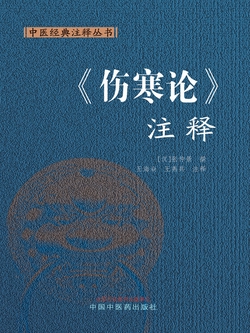
Annotations on the Treatise on Cold Damage
Tags
Summary
Editor's review
Who it's for
A good fit for
- Students of Chinese medicine who have studied basic theories and wish to study the Shanghan Lun in depth
- Physicians in clinical practice who want to deepen their understanding of formula and pattern through a master's annotated edition
- Researchers in literature, history, and medicine interested in the tradition of annotation on Chinese medical classics
Not a good fit for
- General readers with no foundation in Chinese medicine seeking an accessible introduction
- Beginners expecting a modern vernacular translation with sentence-by-sentence comparison
- Readers interested only in health preservation who do not intend to study the original text
Reading tips
- First read the relevant chapters of the original Shanghan Lun, then compare them with Ke Qin's annotation, noting where his analysis of the passages focuses.
- Keep a notebook and extract the key points of pattern differentiation from the annotation, organized by six channel and formula-pattern, for later clinical reference.
- Where the annotation is brief, consult other annotated editions such as those of Cheng Wuji and You Yi, and compare their choices.
About the publisher
Founded in 1989, Qunyan Publishing House has long been committed to publishing academic and educational books for mid- and high-level readers, and has built up a certain presence in Eastern philosophy, classical literature, and classic works. Representative titles available in the database include Records of the Grand Historian, Dream of the Red Chamber, Selections of Refined Literature, Complete Song Ci, Strange Tales from a Chinese Studio, Record of Daily Knowledge, Taiping Huimin Hejiju Fang, and The Collected Works of Wang Yangming, covering common categories such as ancient poetry, medicine, and examinations. Its author resources include Sima Qian, Cao Xueqin, Xiao Tong, Li Shan, Pu Songling, and Gu Yanwu. The press also offers distinctive series such as the Biographical Series of the China Democratic League and the Historical Documents Series of the China Democratic League, and publishes research on historical documents, biographies, memoirs, and textbooks and academic works by League members. Public information is limited, and its overall publishing scale and complete catalogue require further verification.
Contents
- 版权信息
- 卷一
- 卷一
- 卷一
- 卷一
- 卷一 桂枝汤证下
- 卷二
- 卷二
- 卷二 麻黄汤证下
- 卷二
- 卷二
- 卷二
- 卷二
- 卷二
- 卷二
- 卷二
- 卷二
- 卷二
- 卷三
- 卷三
- 卷三
- 卷三
- 卷三
- 卷三
- 卷三
- 卷三
- 卷三
- 卷三
- 卷三
- 卷三
- 卷四
- 卷四
- 卷四
- 卷四
- 卷四
- 卷四
- 卷四 真武汤证
- 卷四
- 卷四
- 卷四
- 卷四
- 卷四
- 卷四
- 卷四
- 卷四
- 卷四 猪肤汤证
- 卷四
- 卷四
- 卷四
- 卷四
- 卷四
- 卷四
- 卷四
- 卷四
FAQ
Can I read this annotated edition directly without a foundation in Chinese medicine?
How does Ke Qin's annotated edition differ from other annotations of the Shanghan Lun?
Is this book suitable for clinical doctors to consult in daily practice?
Related on WeRead
Comments
Find this book
This site is an index: you start “Search all sources” in your browser, and the entries it lists all point to third-party sites; please judge their availability yourself.
About the author
Ke Qin's biographical details are limited in publicly available sources; his dates of birth and death, nationality, and similar information are not clearly recorded. Judging from the works that survive, he was a medical author devoted to the study of the Treatise on Cold Damage (Shanghan Lun). Six of his works are held in the collection, including Annotated Treatise on Cold Damage, Collected Works on Cold Damage Laizhu, Supplementary Wings to Cold Damage, and Wings of the Cold Damage Treatise, as well as a guided-reading edition of Collected Works on Cold Damage Laizhu and an unannotated edition of Annotated Treatise on Cold Damage. These works revolve around Zhang Zhongjing's Treatise on Cold Damage, covering textual annotation, analysis of formulas and syndromes, and theoretical elaboration, and belong to the traditional literature of Cold Damage studies in Chinese medicine. His writing centers on annotating the classics and expounding medical theory, with a practical style that emphasizes clarity and pattern differentiation, and has exerted a certain influence within the Cold Damage school. His works are commonly classified under medicine and Eastern philosophy, reflecting a content that touches on both medical theory and classical philosophical thinking.
