

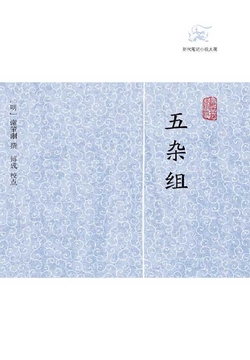
Wu Za Zu (Five Assorted Records)
Tags
Summary
Editor's review
In terms of reading value, this book is a vivid window into the society and culture of the mid- to late Ming. Xie Zhaozhe held posts in many places and was rich in experience, and he recorded many details overlooked by official dynastic histories. His descriptions of regional differences in products between north and south, folk festival customs, commerce and industry, and even price fluctuations, for example, are of great value as historical source material. His comments on the examination system and officialdom also reveal the personal feelings and critical eye of a mid-level literatus. His style is concise and lively, often showing wit amid trifling details, and the book is not without interest to read.
It should be noted that, owing to the limitations of his era, the book contains some rumors and superstitious notions that seem absurd today, and readers should maintain a critical attitude. This edition from Shanghai Classics Publishing House is based on a relatively good original text, with punctuation and collation, removing some textual obstacles for modern readers. Overall, Five Miscellanies is a work of the "miscellaneous school" that deserves slow, careful reading; it does not offer systematic knowledge, but it can carry you across time and space to immerse you in a rich and complex Ming world.
Who it's for
A good fit for
- Readers with a strong interest in Ming social and cultural life
- Enthusiasts who enjoy reading ancient notebooks, essays, and other "miscellaneous books"
- Researchers in ancient Chinese history, folklore, or literary history
- Writers seeking material and inspiration from ancient texts
Not a good fit for
- Readers expecting systematic, thematically organized historical exposition
- Readers of popular works who want tightly plotted, highly narrative books
Reading tips
- You may browse by section—Heaven, Earth, Man, Things, and Affairs—according to interest, without sticking to the order
- It may help to keep a notebook while reading to record interesting entries or obscure allusions for later reference
- Reading it alongside other Ming notebooks (such as Wanli Yehuo Bian and Kezuo Zhu yu) can deepen your understanding of the spirit of the age
About the publisher
Shanghai Classics Publishing House is a professional publisher centered on the collation of ancient texts and academic research works. Its publishing areas cover historical readings, classical poetry, folk literature, literary appreciation, canonical works, and Eastern philosophy. Its books include Chen Yinke's A Brief Discussion of the Origins of the Sui and Tang Institutions, Xin Qiji's Chronological Annotated Edition of Jiaxuan's Ci (Simplified Edition), Tang Xianzu's The Peony Pavilion, Liu Xie's The Literary Mind and the Carving of Dragons, as well as New Annotations to Three Hundred Tang Poems (Collector's Edition), Annotated Edition of Han Changli's Collected Works (Simplified Edition, 3 volumes), and Youyang Zazu. Its authors include Chen Yinke, Xin Qiji, Tang Xianzu, Liu Xie, Deng Guangming, Hengtang Tuishi, Han Yu, and Ma Qichang. In terms of publishing characteristics, the house emphasizes collation, annotation, and compilation of ancient texts alongside academic research works, and continues to issue simplified and collector's editions that balance scholarship and accessibility. Public information about the publisher's fuller publishing profile is limited.
Contents
- 版权信息
- 校点说明
- 五杂组序
- 卷之一 天部一
- 卷之二 天部二
- 卷之三 地部一
- 卷之四 地部二
- 卷之五 人部一
- 卷之六 人部二
- 卷之七 人部三
- 卷之八 人部四
- 卷之九 物部一
- 卷之十 物部二
- 卷之十一 物部三
- 卷之十二 物部四
- 卷之十三 事部一
- 卷之十四 事部二
- 卷之十五 事部三
- 卷之十六 事部四
- 跋
- 历代笔记小说大观总目
FAQ
What does the title Five Miscellanies mean?
What are the writing style and main features of this book?
What kind of person was the author Xie Zhaozhe?
Related on WeRead



Comments
Find this book
This site is an index: you start “Search all sources” in your browser, and the entries it lists all point to third-party sites; please judge their availability yourself.
About the author
Xie Zhaozhe was a literary figure of the Ming dynasty. Public information about him is limited, and neither his dates nor his birthplace are clearly recorded. The library holds eight of his works, the best known being Wuzazu (Five Assorted Offerings) together with its divided volumes Wuzazu, Part One and Wuzazu, Part Two, as well as Wuzazu (variant title) and three volumes in the series Mingdai Suibi Zhaji: Wuzazu, plus Dianlüe. Judging from the titles and categories, his writing centers on miscellaneous notes and jottings, touching on literary appreciation, Eastern philosophy, and social topics. His style is casual and observant, marked by the broad curiosity and conversational tone common to Ming dynasty biji. Wuzazu circulated widely and offers a window into the intellectual interests and everyday reflections of Ming literati, while Dianlüe concerns local customs and conditions. His works will appeal to readers interested in Ming notebooks and traditional culture.
