

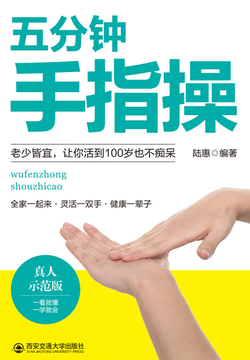
Five-Minute Finger Exercises
Tags
Summary
Editor's review
The content combines text and images, with clear movement breakdowns suitable for readers of all ages to follow. Notably, beyond basic health exercises, the book offers customized plans for specific groups (office workers, middle-aged and older adults, instrument learners), reflecting the author’s professional consideration. Although the book’s design is plain, its practicality and systematic approach deserve recognition.
As an editor, I believe the book’s value lies in making professional rehabilitation knowledge accessible, so ordinary people without a medical background can gain real health benefits through regular practice. It does not pursue complex theoretical exposition but focuses on providing actionable, easy-to-maintain solutions. With hand strain now widespread, this kind of lightweight health guide is of practical relevance. Note that some movements should be adjusted to individual condition; those with serious hand disorders should still consult a physician.
Who it's for
A good fit for
- Office workers who use computers and phones for long periods
- Middle-aged and older adults who want to maintain hand flexibility
- Instrument learners or craft enthusiasts who need fine hand control
- People looking for fragmented health exercise options
Not a good fit for
- Readers expecting complex theory or academic research content
- People with acute hand injuries or severe joint disease requiring professional treatment
Reading tips
- Practice at a fixed time each day, such as after lunch or before bed, to build a habit
- In the early stage, practice in front of a mirror to ensure accuracy
- Combine several five-minute sessions from the book into 15–20 minutes of systematic training
About the publisher
Xi'an Jiaotong University Press focuses its in-house list mainly on health and wellness, inspirational growth and medicine, while also publishing practical English test-preparation titles. Representative works include The Complete Guide to Dietary Dos and Don'ts for Health by Symptom and The Compendium of Materia Medica: Wisdom for Chinese Herbal Wellness, which center on traditional Chinese health preservation and dietary care, as well as English titles such as GMAT Vocabulary Selection, CET-4 Vocabulary: Root and Association Memory Method (Shuffled Edition) and 500 Classic CET-6 Sentences to Memorize. Its authors include Zhang Junli, Wang Chaowei, Wang Hongcai, Zhang Daning, the New Oriental Examination Research Center and Yu Minhong. Given limited public information, a full account of its publishing directions and series system is difficult to provide.
Contents
- 版权信息
- 前言
- 手部反射区
- 第一篇 在开始手指操之前
- 手指操与大脑
- 认识我们的手指
- 手指操基本手型
- 十指热身运动
- 基础手指操
- 第二篇 健脑益智手指操
- “加减法”左手操
- “点将台”单手操
- 协调全脑双手操
- 保健球手指操
- 开枪打鸟
- 旋转手指操
- 弯曲手指操
- 交握手指操
- 手指伸展操
- 手腕柔软操
- 多样手势操
- 第三篇 祛病养生手指操
- 帕金森综合征
- 脑萎缩
- 心律不齐
- 心绞痛
- 高血压
- 过敏症
- 睡眠障碍
- 肾衰竭
- 痔疮
- 腹泻
- 抑郁症
- 糖尿病
- 恶心、呕吐
- 脑卒中
- 便秘
- 腰酸背痛
- 呼吸系统疾病
- 第四篇 日常工作手指操
- 五指按计算器
- 一根手指按键盘
- 两指键盘连打
- 两根手指连夹子
- 换手拿筷子
- 双手写数字
- 双手画图形
- 写镜像汉字
- 单手堆硬币
- 拆装圆珠笔
- 手指移动橡皮筋
- 给格子上色
- 笔放手指上
- 学习打手语
- 第五篇 改善记忆手指操
- 乘法口诀操
- 成语手指操
- 英文字母操
- 汉语拼音声母操
- 计数手指操
- 手指数字操
- 节日手指操
- 第六篇 幼儿启智手指操
- 五指歌
- 编花篮
- 拔萝卜
- 数鸭子
- 孔雀开屏
- 十只小猴子
- 鱼儿游
- 老师早
- 打电话
- 爬楼梯
- 九九消寒歌
- 手指韵律操
- 手掌互拍
- 拳掌互拍
- 手指互握
- 手指分合
- 双手弹指运动
- 单手弹指运动
FAQ
Can people with no exercise background learn it?
How long before I see results?
How is this book different from finger exercises in short videos?
Related on WeRead

Comments
Find this book
This site is an index: you start “Search all sources” in your browser, and the entries it lists all point to third-party sites; please judge their availability yourself.
About the author
Lu Hui is an author about whom limited public information is available. One work by this author is included in the collection: the health book Five-Minute Finger Exercises. Judging from the title and its category, the book uses finger exercises—a simple and easy form of daily exercise—as its starting point, introducing relevant movements and methods to general readers. It emphasizes brevity, ease of learning, and the ability to practice at any time, making it a practical health and wellness guide. Lu Hui's writing stays close to everyday life, with plain language and a focus on practicality, integrating healthy exercise into spare moments. It is suitable for readers who wish to move their bodies lightly and relieve fatigue. Because reliable records of the author's nationality, dates of birth and death, education, and professional experience have not been found, this introduction makes no speculation and offers an objective description based only on the work and category in the collection; the author's English name likewise remains unconfirmed. If more information becomes available, the author's creative background and the book's features could be further supplemented.
