

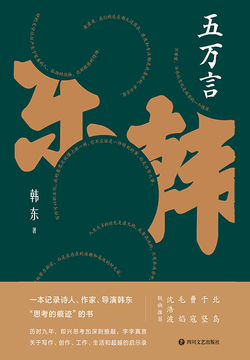
Fifty Thousand Words
Tags
Summary
Editor's review
Who it's for
A good fit for
- Readers with a strong interest in modern poetry and literary theory who wish to understand the poet's core creative ideas
- Readers who enjoy fragmented, aphoristic writing and the stimulus of intellectual collision
- Writers and artists seeking inspiration and points of reference in a predecessor's thinking
- Readers seeking calm, deep writing for self-reflection and inquiry in restless times
Not a good fit for
- Readers expecting structurally complete, narratively continuous traditional essays or autobiography
- Fast readers seeking light entertainment or practical how-to content
Reading tips
- It is best not to read straight through; browse a few passages a day and leave space for savoring and reflection
- Keep a notepad handy to jot down personal thoughts or questions the text provokes
- Read alongside Han Dong's poems (such as "On the Great Wild Goose Pagoda" and "You Have Seen the Sea") to better understand how his poetics are practiced
About the publisher
Sichuan Literature and Art Publishing House is a professional literary and art publishing institution. It mainly publishes books on contemporary and modern literature, foreign literature, poetry and prose, music and art, and literary theory. Judging from the books in the database, the house places considerable emphasis on classic works and foreign literature. Representative titles include Lu Xun's Call to Arms and Dawn Blossoms Plucked at Dusk, Lao She's Camel Xiangzi, Xiao Hong's The Story of Hulan River, J.R.R. Tolkien's The Hobbit, William Shakespeare's Hamlet, and Hermann Hesse's Siddhartha. Its translator resources include Deng Jiawan, Shi Zhongge, Du Yunci, and Zhu Shenghao. Common categories include social fiction, classic works, foreign literature, world classics, literary appreciation, and classical poetry, reflecting a publishing profile that balances Chinese and foreign literary classics with literary appreciation.
Contents
- 版权信息
- 第一部分 写作、创作、工作 (2010-2014)
- 最好的游记是异邦人写的
- 应该每天写
- 简朴不是可以追求的风格
- 诗歌中有语气
- 写作者的骄傲还是骄傲
- 我们身处一个语言的现实
- 好作家让你惊奇
- 有时,你的感觉并不重要
- 第二部分 写作、创作、工作 (2015-2018)
- 诗何以伟大
- 在作品中接受败笔和不完善
- 情绪是用来抑制的
- 现场不需要氛围
- 第三部分 生活和超越 (2010-2018)
- 一些人认识很多年才走近起来
- 警觉的人不丢东西
- 正义的特征总是犹豫不决
- 他们最爱干的事就是炮制偶像
- 真实并不面目狰狞
- 没有家庭温暖的人
- 一切都源于一念
- 一件事如何变得具有“历史感”
- 有堕落者,也有行进在途中的人
- 后记
- 韩东年表
FAQ
Is this book very different in style from Han Dong's novels such as Rooted and The Educated Youth Metamorphosis?
Can I understand this book without a background in poetry or philosophy?
Does "five myriad words" refer to an actual word count?
Related on WeRead


Comments
Find this book
This site is an index: you start “Search all sources” in your browser, and the entries it lists all point to third-party sites; please judge their availability yourself.
About the author
Han Dong is a Chinese author whose work spans several genres; publicly available information about him is limited, making biographical details difficult to confirm. Four of his works are included here, falling under categories such as classic works, modern poetry, social fiction, and management, which suggests that his writing is not confined to a single field. His representative works Fifty Thousand Words and The Birth of a Poet: Han Dong's Poetry Lessons show a sustained engagement with poetry writing and poetry education—the former presenting reflections in an extended essayistic form, the latter reading like course lectures addressed to poetry learners. The novels Disguise and Family Business Inheritance: Interviews with Second-Generation Heirs turn to social themes, the first focusing on characters' circumstances and questions of identity, the second using the interview format to examine family enterprises and generational succession. Overall, Han Dong's writing maintains a tension between poetry and social observation, with a restrained, concrete language that values experience and detail, suited to readers interested in contemporary poetry and social documentary writing.
