

Mid-Autumn
Tags
Summary
Editor's review
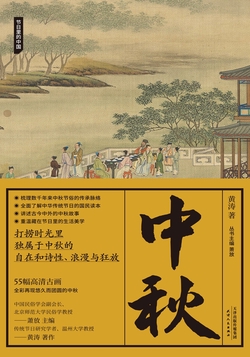
In terms of content, the book is clearly structured. Starting from the origins and legends of the Mid-Autumn Festival (such as Chang'e Flying to the Moon and Wu Gang Felling the Osmanthus Tree), it gradually unfolds discussions of the festival's historical evolution, seasonal activities (moon viewing, eating mooncakes, playing with flower lanterns, etc.), cultural connotations, and contemporary significance. It goes beyond a simple list of customs and deeply analyzes the traditional values carried by the Mid-Autumn Festival, such as family reunion, harmony between heaven and humanity, and celebration of harvest, while considering their inheritance and transformation in modern society.
The reading value of this book lies in its accessible yet profound quality. It cites classics and possesses the rigor of an academic work, while avoiding overly obscure academic expression; the language is plain and fluent, suitable for general readers. For readers who wish to gain a deeper understanding of the cultural texture behind the Mid-Autumn Festival, this book provides a reliable cognitive framework. It can not only enrich readers' knowledge of a single festival but also inspire thought about the entire system of traditional Chinese festivals and even intangible cultural heritage. Today, as traditional festivals become increasingly ritualized and commercialized, reading this book helps us rediscover the emotional depth and cultural warmth behind festivals.
Who it's for
A good fit for
- Readers with a strong interest in traditional Chinese festival culture who wish to know not only what happens but also why
- People working in cultural communication, education, or related fields who need a reserve of folk culture knowledge
- Chinese people living overseas who wish to systematically introduce Chinese Mid-Autumn culture to others
- Readers who like to deepen their festival experience and reflections through reading during festival times
Not a good fit for
- Readers seeking novels, essays, or purely literary works themed on the Mid-Autumn Festival
- Readers who only need simple festival recipes or activity guides and are not interested in in-depth cultural analysis
Reading tips
- It is recommended to read during the Mid-Autumn season, immersing yourself in the atmosphere and feeling the resonance with the descriptions in the text
- It can be used as a cultural reference book, consulting specific customs or historical passages of interest by chapter
- After reading, consider sharing new knowledge from the book with family and friends to add conversation topics to reunion gatherings
About the publisher
Tianjin People's Publishing House publishes across such fields as classic works, foreign literature, architecture, social culture and social sciences, with 749 relevant titles in the collection. In the areas of classics and scholarship, works such as Wang Guowei's Renjian Cihua and Fei Xiaotong's From the Soil and Fertility and Reproduction reflect a sustained attention to social culture and classic texts of thought. Architectural books are represented by Liang Sicheng's Annotated Yingzao Fashi and A History of Chinese Architecture, showing an emphasis on architectural heritage and building traditions. In foreign literature, translations of Sholokhov's And Quiet Flows the Don and Tolstoy's War and Peace and The Death of Ivan Ilyich, through the work of translators such as Li Gang and Yu Dawei, form a substantial series of translated works. Overall, the press combines classic texts, scholarly works and fine translations, with a publishing character oriented toward humanistic depth and the dissemination of knowledge.
Contents
- 版权信息
- 壹 中秋的历史与内涵
- 贰 中秋的故事
- 叁 中秋的纪念物
- 肆 中秋赏月
- 伍 中秋拜月
- 陆 中秋食俗
- 染 中秋庆丰收
- 捌 中秋的游戏娱乐
- 玖 中秋在国外
FAQ
Is this book telling stories about the Mid-Autumn Festival?
Is this book dull or difficult to read?
Is this book suitable as a gift for foreign friends?
Related on WeRead
 中秋(节日里的中国)
 稻香里的约定:春风不问旧人
 锦衣死囚:穿越将门逆子
 画中时砂:修复师的双生轮回
 中秋(文学大家笔下的节日绘本,感受中国传统节俗之美。新锐画家倾情绘制中国风插画。随机附赠节日明信片)
Comments
Find this book
This site is an index: you start “Search all sources” in your browser, and the entries it lists all point to third-party sites; please judge their availability yourself.
About the author
Huang Tao, born in 1964, is a Chinese folklorist with a doctorate in folklore from Beijing Normal University, where he studied under Zhong Jingwen. He taught at Renmin University of China for more than twenty years before moving to Wenzhou University in 2008. He is now a professor at Dehong Normal University, a doctoral supervisor in the School of Literature at Hebei University, editor-in-chief of the journal Folk Culture Forum, and vice president of the China Folklore Society. His research covers folk language, folk literature and traditional festivals, and he is the author of more than twenty books, including Language Folklore and Chinese Culture, An Introduction to Chinese Folk Literature and The Mid-Autumn Festival. Eight of his works are included in the library, spanning politics, culture, popular science, law and health. They range from academic titles such as Renewing China: The State and New Global History, French Neo-Hegelian Political Thought and Philosophy of Law and Common Life, to popular folklore books such as Festivals in China (5 volumes) and The Mid-Autumn Festival, as well as popular science works including Introduction to Quantum Field Theory and The Wonderful World of Particles, and the health book A Family That Loves Sports and Health, reflecting an interdisciplinary range of writing.
