

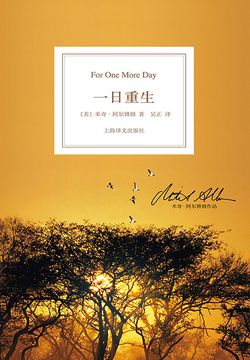
For One More Day
Tags
Summary
Editor's review
From an editor’s perspective, the most moving aspect of this book is the emotional tension beneath its calm narration. Albom does not use flowery language or complicated plot twists; instead, through everyday conversation and tiny details, he peels back layer by layer the neglected truths in the mother-son relationship. What the mother does during the “reborn” day is nothing more than ordinary things—cooking, talking, walking—yet it makes Charlie—and the reader—re-examine how “love” is expressed. This restrained style of writing instead makes the emotional impact more lasting and profound.
In terms of reading value, For One More Day offers a double reflection: on one hand, a renewed understanding of parent-child relationships, reminding us that the seemingly trivial companionship of daily life is often the true vehicle of love; on the other hand, an examination of self-choice, as Charlie keeps asking “if only…”—which is surely a hidden pain in everyone’s heart. Albom’s brilliance lies in not giving standard answers but, through this gentle story, letting readers find answers in their own life experience.
Particularly worth mentioning is this edition from Shanghai Translation Publishing House: the translation is fluent and natural, preserving the emotional warmth of the original very well. Although the book is classified as fiction, the reflections it brings go far beyond literature, touching on psychology and philosophy. For readers who are struggling with family relationships or questioning the meaning of life, this book may serve as a gentle yet effective remedy.
Who it's for
A good fit for
- Adults reflecting on their relationship with their parents and longing for reconciliation
- Readers who have experienced the loss of a loved one and need an emotional outlet
- Literature lovers who enjoy profound philosophy within calm narration
- People at a turning point in life who need to re-examine their choices
Not a good fit for
- Entertainment-seeking readers who prefer fast pacing and strong plots
- Fans of supernatural fiction who expect rigorous logic or scientific explanation
Reading tips
- Read in a quiet environment and give yourself time to savor and reflect
- Read alongside the author’s earlier work Tuesdays with Morrie to understand Albom’s creative trajectory
- After reading, try writing down one unforgettable everyday moment between you and your parents
About the publisher
Shanghai Translation Publishing House is a Chinese publisher oriented mainly toward translation and publishing. Its publications cover foreign literature, world classics and classic works, as well as social culture, folk literature and classical poetry. The database contains 2,618 titles, including Never Let Me Go, Les Misérables (2 volumes), Don Quixote (illustrated collector's edition), The Complete Comedies of Molière (4 volumes), The Complete Novels of Kafka (3 volumes), The Collected Works of Dostoevsky (9-volume set), Reason and Persons, and Oedipus Rex (Translation Classics). Its author resources include foreign writers such as Kazuo Ishiguro, Victor Hugo, Cervantes and Molière, as well as translators such as Zheng Kelu, Sun Jiameng, Li Jianwu and Zhang Kun. The publisher has brands such as "Translation Classics Selections" and "Translation Documentary," and emphasizes translated works in foreign literature and the humanities and social sciences, while also publishing bilingual dictionaries and foreign-language educational books. Public information is limited; the above is based on the book information in the database.
Contents
- 版权信息
- 那个温暖而奇妙的瞬间——《一日重生》导读
- 1.午夜
- 鸡仔的故事
- 鸡仔想一了百了
- 2.早晨
- 鸡仔的妈妈
- 妈妈是如何遇见爸爸的
- 鸡仔回到老宅
- 走调的旋律
- 屋子里的人
- 全新的开始
- 共进早餐
- 离婚后的家
- 散步
- 罗丝
- 尴尬的孩子
- 罗丝道别
- 3.中午
- 鸡仔上大学
- 那天中午
- 鬼魂再现
- 塞尔玛小姐
- 鸡仔的选择
- 你非做不可的事
- 达到顶峰
- 第二次访问结束
- 4.夜晚
- 残阳渐褪
- 他希望能够重过的一天
- 比赛
- 鸡仔发现家没了
- 第三次,也是最后一次访问
- 真相大白
- 故事讲完了
- 鸡仔最后的感想
- 结局
- 致谢 Acknowledgments
FAQ
How does this book compare with Tuesdays with Morrie?
Does the ‘rebirth’ in the story really happen?
Is this book suitable for young readers?
Related on WeRead



Comments
Find this book
This site is an index: you start “Search all sources” in your browser, and the entries it lists all point to third-party sites; please judge their availability yourself.
About the author
Mitch Albom is a contemporary American author whose works are shelved in the Chinese reading market under inspirational growth and foreign literature; the library holds eight of his titles. His best-known work among Chinese readers is Tuesdays with Morrie, alongside The Five People You Meet in Heaven, For One More Day, The Time Keeper and The Next Person You Meet in Heaven. These books mostly take up themes of life, death, family and regret, using stories to explore farewell, redemption and how to face loss, with sincere emotion, concise length and a clear inspirational and healing tone. Public information on his nationality, dates of birth and death and detailed biography is limited, so this entry makes no speculation, and readers may come to know the author mainly through his subjects and writing style.
Public information about Wu Zheng is limited, and basic details such as his nationality and dates of birth and death cannot be confirmed. Judging from the ten works held in the collection, his writing spans several genres: there are works with narrative tension and imaginative flavor, such as One Day Reborn and The Time Keeper, as well as pieces leaning toward personal essays and urban writing, such as Three Volumes of a Floating Life, Love Lost in Two Cities, Shanghai People, and Rear Window. The Abyss and Half a Long Night are closer in spirit to social novels and classic works, while volumes such as Three Volumes of a Floating Life also touch on modern poetry. Overall, Wu Zheng moves between urban experience and personal emotion, with a delicate style and subjects that shift between realistic portrayal and legendary narrative, which is why his work is classified under foreign literature, essays and miscellany, and social fiction. Owing to the scarcity of biographical material, his creative background and literary lineage are difficult to describe in detail; readers may chiefly come to know his writing through the works listed above.
