

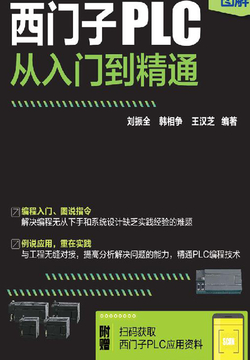
PLC: From Beginner to Mastery
Tags
Summary
Editor's review
In the editor's view, the book's organization embodies a philosophy of "progressive mastery." The introductory chapters review electrical fundamentals to lower the learning threshold, while the "mastery" section addresses redundancy systems, fault diagnosis, and other topics that respond to engineers' deeper needs in actual operation and maintenance. The comparative treatment of PLCs from mainstream brands (such as Siemens and Mitsubishi) further enhances the content's practicality. It is worth noting that while the book focuses on technical exposition, its language is concise and its diagrams are detailed; this "engineer writing for engineers" tone reduces the cognitive load of reading. For readers who wish to build a solid knowledge system in industrial automation and seek a leap from understanding principles to project-level practical capability, this book offers a reliable and efficient path. It is less a textbook than an experienced mentor who breaks a vast technical system into modules that can be mastered step by step.
Who it's for
A good fit for
- Students in automation, electrical engineering, and related majors, who can use it as a core textbook or supplementary reading
- Front-line personnel such as factory electrical technicians and equipment maintenance engineers who wish to systematically improve their PLC programming and application skills
- Engineers engaged in the design and integration of industrial control systems, especially those who need to fill knowledge gaps or broaden their technical horizons
- Self-learners with a strong interest in industrial automation and a basic foundation in electrical and electronic engineering
Not a good fit for
- Readers who expect to quickly master every detail of a specific model from a single PLC brand (for example, Siemens only); this book's content is more general-purpose
- Complete beginners with no foundation in electrical control who are unwilling to first acquire electrical knowledge and come from a pure software background
Reading tips
- It is recommended to study the chapters in order and to complete hands-on, or at least understand, the exercises and cases at the end of each chapter; practice is key to mastering PLCs
- While reading, compare the book's general principles with the manual of the PLC brand you actually use to deepen understanding
- For difficult chapters such as "Communication" and "PID Control," supplement your study with simulation software or video tutorials available online
About the publisher
Posts & Telecom Press is known for its strengths in science and technology, computing, and information and communications titles, and has extended its publishing into photography, art, software learning, and inspirational growth, giving it a fairly diverse range. Its catalog includes computing and communications works such as Refactoring and Patterns (Revised Edition) and Huawei Switch Learning Guide (Second Edition), alongside bilingual collector's editions such as The Little Prince (Chinese-English-French illustrated collector's edition), The Great Gatsby, and Three Days to See. Beijing Ten Years: 1980-1990 and Ghost Blade: WLOP Personal Illustration Collection reflect its presence in photography and art. Its authors include Antoine de Saint-Exupéry, Helen Keller, Joshua Kerievsky, Wang Da, Zhang Zhaozeng, and WLOP.
Contents
- 版权信息
- 内容提要
- 前言
- 基础篇
- 第1章 可编程控制器概述
- 1.1可编程控制器的产生和定义
- 1.2可编程控制器的特点与主要功能
- 1.3可编程控制器的应用与发展趋势
- 1.4可编程控制器的分类
- 1.5本章小结
- 1.6习题与思考
- 第2章 可编程控制器的基本结构、组成及工作原理
- 2.1可编程控制器的基本结构
- 2.2可编程控制器的组成
- 2.3可编程控制器的基本工作原理
- 2.4本章小结
- 2.5习题与思考
- 第3章 编程基础知识引入
- 3.1进制概述
- 3.2二进制运算
- 3.3位和字
- 3.4 PLC数据类型
- 3.5脉冲信号和时序图
- 3.6编程软元件
- 3.7基本逻辑门电路
- 3.8本章小结
- 3.9习题与思考
- 编程篇
- 第4章 可编程控制器的编程语言
- 4.1梯形图语言
- 4.2功能块图语言
- 4.3指令表语言
- 4.4结构化文本语言
- 4.5顺序功能图语言
- 4.6国际标准语言
- 4.7本章小结
- 4.8习题与思考
- 第5章 FX系列指令系统
- 5.1基本指令
- 5.2应用指令
- 5.3本章小结
- 5.4习题与思考
- 第6章 三菱PLC编程软件
- 6.1 FX-GP/WIN-C编程软件
- 6.2 GX Developer编程软件
- 6.3 GX Works2编程软件
- 6.4本章小结
- 6.5习题与思考
- 第7章 PLC码垛机器人控制系统
- 7.1结构设计
- 7.2控制系统总体设计
- 7.3 PLC相关元件选型
- 7.4系统功能设计
- 7.5空间四轴脉冲坐标系确定
- 7.6 PLC系统软件设计
- 第8章 PLC液体混合控制系统
- 8.1整体控制要求
- 8.2 PLC相关元件选型
- 8.3硬件设计
- 8.4软件设计
- 8.5系统运行与调试
- 8.6总结与评价
- 第9章 PLC工业电镀流水线控制系统
- 9.1整体控制要求
- 9.2 PLC相关元件选型
- 9.3硬件设计
- 9.4软件设计
- 参考文献
FAQ
Which PLC brand does this book mainly cover?
How much electrical background do I need to understand this book?
Does the book include actual program code and project files?
Related on WeRead
Comments
Find this book
This site is an index: you start “Search all sources” in your browser, and the entries it lists all point to third-party sites; please judge their availability yourself.
About the author
Zhou Lifang, about whom limited public information is available, appears from the works held in the library to focus on the field of industrial technology, especially introductory and intermediate readers on programmable logic controllers (PLCs). Two works by this author can currently be identified: From Beginner to Mastery: Siemens S7-300/400 PLC and From Beginner to Mastery: PLC, both technical popularization books in the area of automation and control. Judging from their titles, the two books are aimed at beginners and self-learners, using the Siemens S7-300 and S7-400 series as concrete subjects to explain the basic principles of PLCs, hardware configuration, programming methods, and engineering applications. In approach they emphasize progressing from the simple to the deeper, step by step, so that readers can master operating essentials in sequence. Books of this kind serve industrial control practitioners, vocational college students, and people changing careers, and have a certain practical value among introductory works on automation technology.
Yang Meimei: publicly available information is limited, and at present she is known only as the author of PLC from Beginner to Mastery, a book classified under industrial technology. Judging from the title and category, the work is aimed at beginners and self-learners of PLCs (programmable logic controllers), and its content presumably focuses on fundamental knowledge and hands-on basics, helping readers grasp the key technical points step by step. Based on the available information, her nationality, dates of birth and death, educational background, professional experience, and honors cannot be confirmed, nor should excessive inferences be made about her writing style or influence in the field. What can be established is that Yang Meimei has entered readers' view with an introductory technical book, and her signed work offers a reference point for learners in the field of industrial automation.
Zhang Huachuan: currently, publicly available information is limited, and no confirmed records of his identity or personal background have been found. According to the library's holdings, Zhang Huachuan has one work in the industrial technology category, PLC from Beginner to Mastery, a practical technical book aimed at beginners and self-learners of programmable logic controllers, taking readers from introductory to more advanced levels. Based on the available information, his writing emphasizes a systematic organization of technical knowledge and explanation at the operational level, guiding readers from the basics toward an understanding and mastery of the fundamental principles and applications of PLCs. It is suitable for readers who wish to study PLCs systematically. Because the author's background, professional qualifications, and writing career lack verifiable material, this introduction is based solely on the work information and category available in the library, and makes no speculation about his life.
