

Complete Java Self-Study Tutorial
Tags
Summary
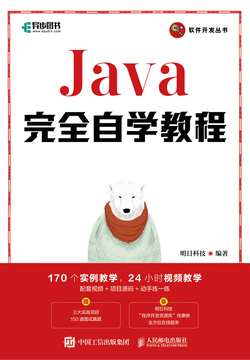
The book has 18 chapters in four parts. The Basics part covers data types, operators, and more; the Intermediate part covers arrays, object-oriented programming, exception handling, and more; the Advanced part covers Swing programming, threads, and more; and the Project part walks through building a development plan management system. Concepts are explained through concrete examples, and the code is thoroughly commented, so readers can grasp the essentials of Java programming with ease and quickly raise their programming skills.
Editor's review
Who it's for
A good fit for
- Complete beginners with no programming background who want to learn Java systematically
- Computer science students seeking a hands-on textbook to accompany their coursework
- Junior programmers looking to move to Java from another language
- Hobbyists who want a clearly structured, example-rich reference for self-study and lookup
Not a good fit for
- Intermediate and advanced developers seeking in-depth, hands-on guides to the latest Java frameworks (such as Spring Boot and microservice architecture)
- Readers who want to quickly master specialized skills in a specific area (such as Android development or big data processing)
Reading tips
- Follow the chapters in order, and be sure to run the sample code and complete the end-of-chapter exercises to consolidate your understanding.
- As you study, consult the official documentation or online programming communities to explore the core classes and methods mentioned in the book in greater depth.
- After finishing the basics, choose advanced topics that match your interests (such as web development or mobile apps) for targeted study and practice.
About the publisher
Posts & Telecom Press is known for its strengths in science and technology, computing, and information and communications titles, and has extended its publishing into photography, art, software learning, and inspirational growth, giving it a fairly diverse range. Its catalog includes computing and communications works such as Refactoring and Patterns (Revised Edition) and Huawei Switch Learning Guide (Second Edition), alongside bilingual collector's editions such as The Little Prince (Chinese-English-French illustrated collector's edition), The Great Gatsby, and Three Days to See. Beijing Ten Years: 1980-1990 and Ghost Blade: WLOP Personal Illustration Collection reflect its presence in photography and art. Its authors include Antoine de Saint-Exupéry, Helen Keller, Joshua Kerievsky, Wang Da, Zhang Zhaozeng, and WLOP.
Contents
- 版权信息
- 内容提要
- 前言
- 基础篇
- 第1章 搭建Java开发环境
- 第2章 走进Java
- 第3章 数据类型
- 第4章 运算符
- 第5章 流程控制语句
- 提高篇
- 第6章 数组
- 第7章 面向对象编程
- 第8章 异常的捕获与处理
- 第9章 字符串
- 第10章 Java常用类
- 第11章 泛型类与集合类
- 高级篇
- 第12章 Swing程序设计
- 第13章 AWT绘图
- 第14章 输入/输出流
- 第15章 线程
- 第16章 网络通信
- 第17章 使用JDBC操作数据库
- 项目篇
- 第18章 开发计划管理系统
FAQ
Is this book suitable for someone with no programming experience at all?
Which Java version are the code examples based on?
What level can I reach after finishing this book?
Related on WeRead
Comments
Find this book
This site is an index: you start “Search all sources” in your browser, and the entries it lists all point to third-party sites; please judge their availability yourself.
About the author
Mingri Technology, whose full name is Jilin Province Mingri Technology Co., Ltd., is a high-tech company specializing in software development, education and training, and the integration of software development educational resources, and it organizes the compilation of computer programming textbooks. Its works are aimed mainly at programming beginners and focus on learning languages such as Python, Java, C#, and SQL, as well as GUI design and web front-end development; its common categories are programming design, computer fundamentals, and software learning. Representative works include the upgraded editions of Python GUI Design, SQL, and Java in the “Zero Foundation Learning” series, along with study notes on HTML+CSS+JavaScript and a complete self-study course on C#. The company has developed textbook series such as “From Beginner to Master” and “Software Development Video Lecture Hall”; related textbooks have received industry and university press awards, and several titles have long ranked among the top sellers in their categories. Public information is limited; the author name is an institutional byline, and the focus is on the compilation and publication of computer programming educational materials.
