

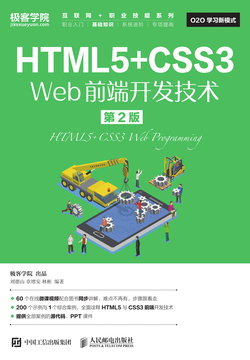
HTML5+CSS3 Web Front-End Development Technology (2nd Edition)
Tags
Summary
Editor's review
From a professional perspective, the book is clearly structured and follows a learning path from fundamentals to advanced topics, with each chapter featuring abundant example code and end-of-chapter exercises, making it well suited to classroom teaching and self-study. The author, Liu Deshan, has many years of university teaching experience, and his writing style is rigorous and precise, presenting complex technical concepts in an easy-to-understand way. The book explains HTML5's new APIs and CSS3 effects such as animations and transitions in particular detail, providing readers with a solid theoretical foundation for building dynamic, interactive web pages.
However, the book focuses more on fundamental knowledge and standard syntax and covers relatively little of the frameworks (such as Vue and React) and engineering tools popular in today's front-end ecosystem. It is therefore better suited as a "first book" on front-end technology, helping readers build a solid core skill set rather than directly tackling enterprise-level project development. Overall, this is a reliable, comprehensive traditional textbook, suitable for readers who need to systematically learn Web standards technologies.
Who it's for
A good fit for
- College students majoring in computer-related fields, as a textbook or reference book for web design or front-end development courses
- Career changers or beginners who want to systematically learn HTML5 and CSS3 standard syntax and core concepts from scratch
- Front-end practitioners with some traditional web authoring experience (such as HTML4) who need to update their knowledge to modern Web standards
- Developers who need a clearly structured, example-rich reference book for daily lookup of tags, attributes, and CSS properties
Not a good fit for
- Impatient learners seeking to quickly get started with modern front-end frameworks such as Vue and React and immediately put them into project development
- Senior developers who have already mastered HTML5/CSS3 and wish to explore front-end engineering, performance optimization, or advanced techniques in specific domains
Reading tips
- It is recommended to study the chapters in order and practice each example code hands-on, which is the most effective way to master front-end technologies
- When learning CSS3 layout (such as Flexbox), practice with online visualization tools to deepen understanding of the layout model
- After finishing the book, try to independently complete a simple responsive personal homepage project modeled on the book's case studies, in order to integrate what has been learned
About the publisher
Posts & Telecom Press is known for its strengths in science and technology, computing, and information and communications titles, and has extended its publishing into photography, art, software learning, and inspirational growth, giving it a fairly diverse range. Its catalog includes computing and communications works such as Refactoring and Patterns (Revised Edition) and Huawei Switch Learning Guide (Second Edition), alongside bilingual collector's editions such as The Little Prince (Chinese-English-French illustrated collector's edition), The Great Gatsby, and Three Days to See. Beijing Ten Years: 1980-1990 and Ghost Blade: WLOP Personal Illustration Collection reflect its presence in photography and art. Its authors include Antoine de Saint-Exupéry, Helen Keller, Joshua Kerievsky, Wang Da, Zhang Zhaozeng, and WLOP.
Contents
- 版权信息
- 内容提要
- 第2版前言
- 第1部分 HTML5及其应用
- 第1章 HTML5概述
- 1.1 HTML5简介
- 1.2 HTML5与HTML4的区别
- 1.3 HTML5的特性
- 1.4 HTML5的开发环境
- 思考与练习
- 第2章 HTML5的文档结构元素
- 2.1 HTML的元素和属性
- 2.2 HTML文档的基本结构元素
- 2.3 HTML5新增的结构元素
- 思考与练习
- 第3章 HTML5的基本页面元素
- 3.1 文本元素
- 3.2 列表元素
- 3.3 超链接元素
- 3.4 图像元素和多媒体元素
- 3.5 表格元素
- 3.6 内嵌框架
- 3.7 页面基本元素的应用
- 思考与练习
- 第4章 HTML5的表单元素
- 4.1 表单定义元素form
- 4.2 HTML表单输入元素及属性
- 4.3 HTML5新增的表单元素和属性
- 4.4 一个会员注册表单
- 思考与练习
- 第5章 HTML5的video元素和audio元素
- 5.1 HTML5的video元素
- 5.2 HTML5的audio元素
- 5.3 使用track元素添加字幕
- 思考与练习
- 第6章 HTML5的canvas绘图
- 6.1 canvas概述
- 6.2 绘制矩形
- 6.3 使用路径绘制图形
- 6.4 绘制颜色渐变的图形
- 6.5 使用坐标变换和矩阵变换绘图
- 6.6 在canvas中使用图像
- 6.7 绘制文字
- 6.8 使用canvas绘制动画
- 思考与练习
- 第7章 HTML5的SVG绘图
- 7.1 SVG概述
- 7.2 绘制SVG基本图形
- 7.3 变换
- 7.4 组合与重用
- 7.5 渐变与透明度
- 7.6 滤镜
- 思考与练习
- 第8章 获取浏览器的地理位置信息
- 8.1 地理位置信息概述
- 8.2 地理位置信息使用过程
- 8.3 地理位置API
- 8.4 获取地理位置信息的应用
- 思考与练习
- 第9章 离线Web应用与Web存储
- 9.1 离线Web应用
- 9.2 离线Web应用的实现
- 9.3 Web Storage概述
- 9.4 Web Storage应用
- 思考与练习
- 第10章 使用WebWorkers处理线程
- 10.1 Web Workers概述
- 10.2 页面与线程的数据交互
- 10.3 使用SharedWorker创建共享线程
- 思考与练习
- 第11章 HTML5的IndexedDB数据库
- 11.1 IndexedDB数据库概述
- 11.2 创建数据库
- 11.3 数据库的版本更新和事务处理
- 11.4 创建对象仓库
- 11.5 创建索引
- 11.6 保存和删除数据
- 11.7 使用游标检索批量数据
- 思考与练习
- 第12章 HTML5的文件操作与拖放操作
- 12.1 file对象和FileList对象
- 12.2 ArrayBuffer对象与ArrayBufferView对象
- 12.3 Blob对象
- 12.4 FileReader接口
- 12.5 拖放API
- 12.6 DataTransfer对象的属性与方法
- 12.7 拖放的应用
- 思考与练习
- 第2部分 CSS3及其应用
- 第13章 CSS3的选择器
- 13.1 CSS3概述
- 13.2 CSS的基本选择器
- 13.3 在HTML中使用CSS的方法
- 13.4 CSS复合选择器
- 13.5 CSS3新增的选择器
- 13.6 使用CSS设计网站页面
- 思考与练习
- 第14章 使用CSS3设置元素样式
- 14.1 用CSS3设置文本样式
- 14.2 用CSS3设置颜色与背景
- 14.3 用CSS3设置图像效果
- 14.4 用CSS3美化页面的应用
- 思考与练习
- 第15章 CSS3的盒模型及网页布局
- 15.1 CSS盒模型
- 15.2 CSS布局常用属性
- 15.3 CSS的网页布局
- 15.4 DIV+CSS布局的应用
- 思考与练习
- 第16章 CSS3的响应式布局
- 16.1 响应式布局简介
- 16.2 使用Bootstrap实现响应式布局
- 思考与练习
- 第3部分 综合案例
- 第17章 综合案例1——在线旅游网站的设计与实现
- 17.1 使用HTML 5结构元素组织网页
- 17.2 页头部分的设计
- 17.3 侧边导航和焦点图的设计
- 17.4 快速搜索、滑动Tab和在线咨询板块设计
- 17.5 特色线路板块的设计
- 17.6 页脚的设计
- 思考与练习
- 第18章 综合案例2——订单管理网站的设计与实现
- 18.1 案例功能描述
- 18.2 用户登录注册模块设计
- 18.3 订单管理模块设计
- 18.4 客户管理模块设计
- 思考与练习
- 附录 HTML标记列表
- 参考文献
FAQ
Is this book suitable for someone with no programming background at all?
Is the technical content in the book outdated?
What are the advantages of this book compared with online tutorials or video courses?
Related on WeRead
Comments
Find this book
This site is an index: you start “Search all sources” in your browser, and the entries it lists all point to third-party sites; please judge their availability yourself.
About the author
Liu Deshan is an author writing in computer-related fields, though publicly available information about him is limited, and details of his life and background cannot be verified. Judging from the four works held in the collection, his writing focuses on two areas: web front-end development and programming. These include HTML5+CSS3 Web Front-End Development Technology and its second edition, as well as Python 3 Programming. He has also addressed software design methods in Java Design Patterns and Application Cases (2nd Edition). Categorized under computer basics, programming design, and examinations, these works cover both practical web page construction and scripting languages, and the application of object-oriented patterns, reflecting an approach that combines foundational introductions with engineering practice. They are suitable as course textbooks or self-study references. Given the lack of biographical material, his writing style and actual influence are difficult to assess in detail.
Zhang Zeng'an is a Chinese author of computer books, though limited public information is available about him. What can be confirmed is that he has written two works: HTML5+CSS3 Web Front-End Development Technology and its second edition. Both books center on HTML5 and CSS3, the two core technologies of web front-end development, and are aimed at learners in programming design and general computing. Their content focuses on the fundamentals and practical application of front-end development. Judging from the subject matter, Zhang's writing concentrates on introducing and advancing specific technologies, making his books typical technical tutorials suitable for readers who wish to systematically learn web structure and styling. The appearance of a second edition suggests that the first edition found a readership, prompting the author to update and refine the content. Overall, Zhang Zeng'an's main writing focus is web front-end development technology, and his works offer some reference value for basic computer teaching and self-study. However, owing to limited public information, further details about his personal background and academic experience cannot be provided.
Public information about Lin Bin is limited, and his nationality, dates of birth and death, and professional background cannot be confirmed at present. Judging from the three works held in the library, his writing interests span computer technology, medical history, and world history, covering a fairly wide range of subjects. Among them, HTML5+CSS3 Web Front-End Development Technology (2nd Edition) is a practical textbook in programming and design for learners of web development; The Arduous Journey of Founding Medical Education, a Century of Glory in Cultivating Talent: A Historical Picture Album of Modern Chinese Medicine Education in Guangdong traces the development of modern Chinese medicine education in Guangdong in an illustrated, accessible manner, combining historical value with readability; and A Concise World History (New Knowledge Family Civilization Reader) outlines the course of world history in a concise style for general readers. These works correspond respectively to the categories of programming and design, medicine, and world history, reflecting the author's engagement with different fields of knowledge and his orientation toward popular writing.
